The 3-Pass Subtitle Method for Stronger Listening Skills
Last updated on
Editorial owner: Taylor Freeman · Editorial policy
You turn on a show in your target language, choose subtitles in your native language, and finish the episode feeling productive. But if your eyes did most of the work, your ears may have learned far less than you think.
That does not mean subtitles are bad. Research on captioned video generally finds that captions can support second-language listening and vocabulary learning. The problem is how learners use them. Translated subtitles can become a comfortable replacement for listening; target-language captions can become a useful diagnostic tool. The difference is one small change in sequence.
This guide explains a practical three-pass subtitle method: listen first, check second, and speak third. It works with a short scene, interview, news clip, or lesson, and it turns passive viewing into focused listening practice without ruining your evening.
Why subtitles can create an illusion of listening
Reading is fast, especially in your strongest language. When translated subtitles appear, your brain can follow the meaning before it has fully processed the sound. You understand the plot, but understanding the plot is not the same as recognizing connected speech.
Real conversation asks you to do several things at once:
- separate a fast sound stream into words and phrases;
- recognize reduced sounds, contractions, accents, and rhythm;
- hold one idea in memory while the next one arrives;
- infer meaning when you miss a word;
- prepare a response before the other person finishes.
Subtitles remove some of that pressure. That is useful when the support helps you notice what you missed. It is less useful when the support stays on from beginning to end.
A meta-analysis of captioned video for second-language learning found benefits for listening and vocabulary, while other research has examined how heavily learners can come to rely on captions. The sensible takeaway is not “never use subtitles.” It is: use them as feedback, not as permanent training wheels.
The subtitle ladder: support should arrive after effort
The method below uses one clip of roughly 30 to 90 seconds. A short clip is important because you will replay it. Pick dialogue with clear audio and a situation you can understand from context. A scene about ordering food, changing a reservation, meeting a colleague, or explaining a problem works better than a long monologue full of specialist vocabulary.
Pass 1: Listen with no subtitles
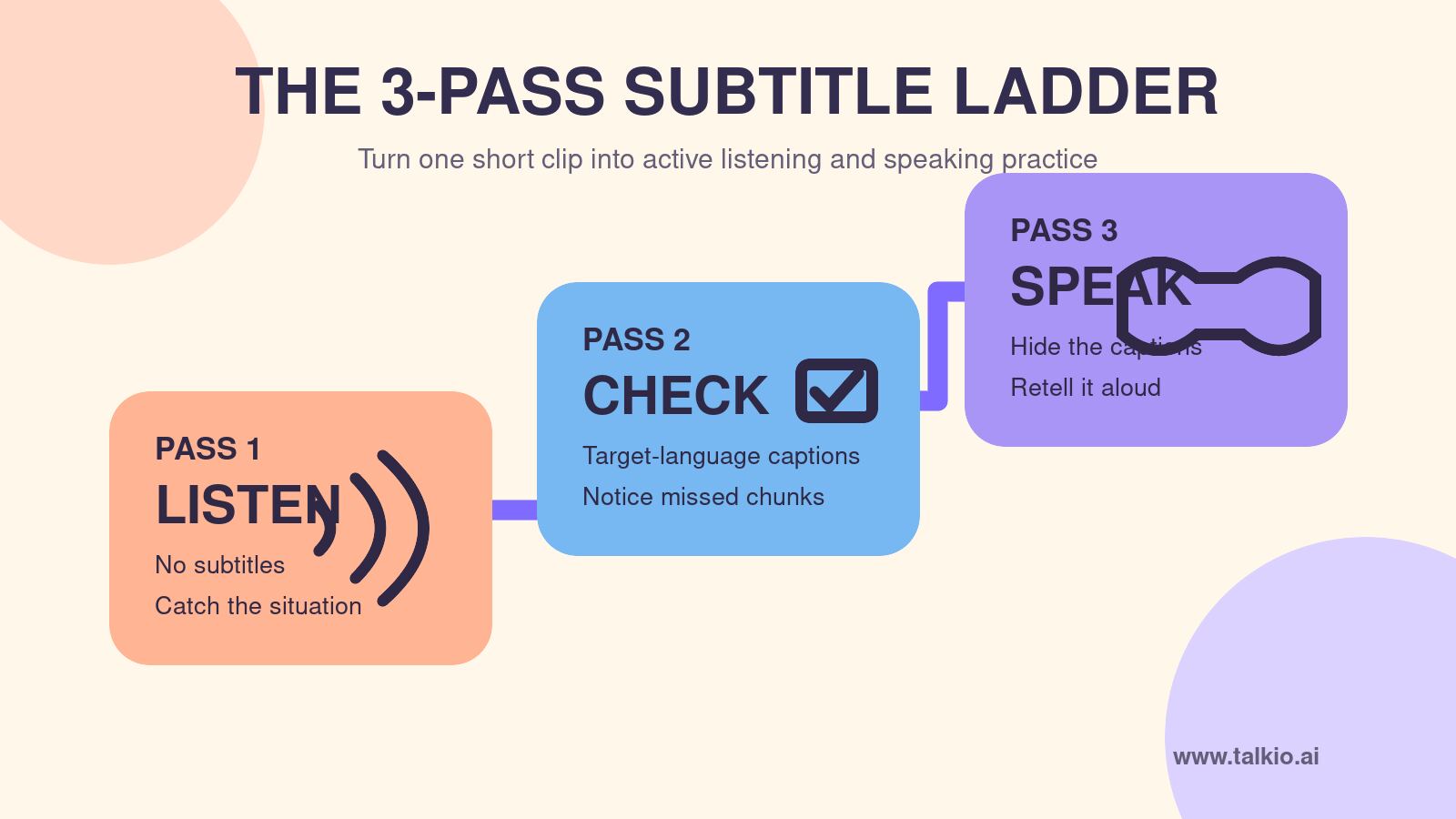
Play the clip once without captions. Do not pause for every unknown word. Your job is to catch the situation, not produce a transcript.
After the clip, answer four quick questions:
- Who is speaking?
- What do they want?
- What changed during the exchange?
- Which three to five words or chunks did you hear clearly?
Give yourself a rough comprehension score from 0 to 5. A score of 2 is not failure; it is a baseline. If you can already follow everything, choose a harder clip or a less familiar accent.
Pass 2: Check with target-language captions
Replay the same clip with captions in the language you are learning. Pause only after a complete sentence or thought group. Compare the written line with what you thought you heard.
Look for the reason behind each miss:
- Unknown word: You heard the sound but did not know the meaning.
- Known word, hidden sound: You know the word on paper but did not recognize it in fast speech.
- Word boundary: Two or more words blended together.
- Grammar signal: A small word or ending disappeared in the flow.
- Attention gap: You were still translating the previous sentence.
Write down no more than three useful chunks. Choose phrases you might actually say, such as “Could you say that again?”, “I was wondering if…”, or “That works for me.” Learning chunks can make speaking faster because you retrieve a ready-made unit instead of building every sentence word by word. For a deeper practice routine, see Talkio’s guide to learning language chunks for faster speaking.
Pass 3: Hide the captions and speak
Turn the captions off. Listen again, then do one active output task:
- repeat one line while copying its rhythm and stress;
- pause and predict the next reply;
- retell the exchange in your own words;
- play one role and answer the other speaker;
- change one detail and continue the conversation.
This third pass is the part most people skip. It is also what connects listening to speaking. If shadowing alone feels mechanical, combine it with the 15-minute speaking loop: imitate, change, respond, and reuse.
Native-language subtitles, target-language captions, or no captions?
Each option has a purpose. The mistake is treating them as interchangeable.
| Mode | Best use | Main risk |
|---|---|---|
| No captions | Testing real-time listening and using context | The clip may be too hard to diagnose |
| Target-language captions | Matching sounds to words and noticing chunks | You may read instead of listen |
| Native-language subtitles | Checking plot or meaning after serious confusion | Your strongest language takes over |
If you are a beginner, it is reasonable to use translated subtitles briefly after the first attempt. Then return to target-language captions and finish without captions. Intermediate learners should usually make target-language captions their main checking layer. Advanced learners can use captions to investigate accents, idioms, or dense sections rather than leaving them on for the whole video.
A 12-minute subtitle practice routine
You do not need an entire film. Use this checklist with one short clip:
- Choose (1 minute): Select 30–90 seconds with useful everyday speech.
- Listen (2 minutes): Play without subtitles and note the situation plus three words you caught.
- Check (3 minutes): Turn on target-language captions and identify up to three missed chunks.
- Listen again (1 minute): Hide captions and confirm that the previously “invisible” words are now audible.
- Speak (3 minutes): Repeat, retell, or roleplay the scene aloud.
- Transfer (2 minutes): Use each new chunk in a different sentence or scenario.
For example, after a hotel check-in scene, do not merely repeat “I have a reservation.” Change the date, room type, problem, and tone. Then rehearse the situation in an interactive speaking session. Talkio supports guided practice across many accents and varieties, including American English and Spanish from Spain.
How to choose clips that improve listening
The best clip is not necessarily the most entertaining one. For deliberate practice, choose material with:
- clean audio and visible conversational context;
- one or two speakers rather than a crowded group;
- a topic you mostly understand;
- captions that match the audio closely;
- phrases you could reuse in real life;
- a difficulty level where you catch roughly half to four-fifths on the first pass.
TED Talks can be useful for clear, transcript-supported speech, while YouGlish helps you hear a word or phrase across many real video examples. For level-structured material, the British Council’s listening practice organizes activities by proficiency level.
Avoid jumping straight to the hardest drama you can find. If every sentence needs translation, you are testing endurance more than listening. Build up from clearer speech, then vary speed and accent. Talkio’s article on why some languages sound so fast explains why rhythm and information density can feel overwhelming even when the actual speech rate is not extreme.
Five subtitle mistakes that slow progress
- Watching for hours without replaying anything. Exposure is helpful, but a short repeated section gives you a chance to notice specific sound patterns.
- Saving every unknown word. A list of 25 words is unlikely to become usable speech. Keep two or three high-value chunks.
- Pausing before the sentence ends. Meaning often becomes clear from the full thought group. Constant pausing also destroys natural rhythm.
- Copying captions silently. Recognition is not production. Say the phrase, change it, and use it in a reply.
- Practicing only one speaker or accent. Listening improves when you gradually vary voice, age, speed, and regional pronunciation. If accent anxiety is holding you back, read why speaking like a native may be overrated.
How to know the method is working
Do not measure progress by episodes completed. Track behaviors that transfer to conversation:
- You need fewer replays to understand a similar clip.
- You recognize reduced forms and word boundaries sooner.
- You can summarize the message without translating every line.
- You reuse new chunks during an unscripted reply.
- You recover calmly when you miss part of a sentence.
Conversation repair is a real listening skill, not a sign of weakness. Practice phrases such as “Did you mean…?”, “Could you say the last part again?”, and “So, if I understood correctly…”. Talkio’s collection of 12 conversation repair phrases gives you useful options.
Frequently asked questions
Should beginners use subtitles in their native language?
Yes, but selectively. First try the clip without subtitles, then use native-language subtitles only to repair a major meaning gap. Switch to target-language captions to connect sounds with words, and finish with captions off.
Are target-language captions always accurate?
No. Automatic captions can mishear names, accents, and fast speech, while professionally prepared subtitles may shorten or rewrite dialogue. Treat captions as evidence, not unquestionable truth.
How long should a practice clip be?
Thirty to 90 seconds is enough. The goal is repeated, attentive practice. Once you can follow and reuse the language, move to a new clip.
Can I learn speaking by watching videos alone?
Video can supply models, vocabulary, and listening practice, but speaking also requires retrieval and response. Retell the clip, roleplay it, or practice a related scenario with an AI conversation partner. If you understand a lot but freeze when answering, the problem may be the output gap, not a lack of knowledge.
Try the method tonight
Pick one short scene instead of one full episode. Listen without help. Check the target-language captions. Hide them. Then say something new with the phrases you noticed.
The surprising part is not that subtitles can help. It is that they help most when you delay them long enough to discover what your ears actually need. That small moment of effort—before the text appears—is where passive watching starts becoming listening practice.
Talk Your Way
to Fluency
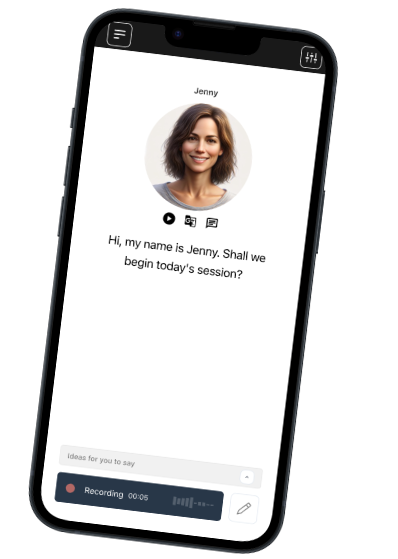
Talkio is the ultimate language training app that uses AI technology to help you improve your oral language skills!
Try Talkio