
Shadowing Is Not Enough: The 15-Minute Speaking Loop That Makes Languages Stick
Last updated on
Editorial owner: Kier Lee Zamora · Editorial policy
Shadowing has become the internet’s favorite speaking hack: play a native speaker, copy the sound, repeat until your mouth feels faster. It is useful. It can train rhythm, pronunciation, and confidence.
But here is the uncomfortable part: many learners shadow for months and still freeze when a real person asks an unexpected question.
The problem is not effort. The problem is that shadowing is mostly copying. Conversation is choosing. You have to hear meaning, decide what to say, build a sentence, say it under pressure, notice what went wrong, and try again. That loop is where speaking skill grows.
This article gives you a practical 15-minute speaking loop you can use with an AI language tutor, a human tutor, or a patient conversation partner. It is designed for busy adult learners who want better real-world speaking, not just better app streaks.

Why shadowing feels productive but often does not transfer to conversation
Shadowing works because it removes many hard parts of speaking. You do not need to choose vocabulary. You do not need to organize a thought. You do not need to repair a mistake. You simply follow a model.
That makes shadowing a good warm-up. It is especially helpful if you are working on sound, stress, or rhythm. Research on second-language pronunciation and fluency often points to the value of repeated, attention-focused practice, and resources from organizations like the Cambridge English learning hub and the British Council encourage learners to combine listening, speaking, and feedback.
But shadowing alone can hide three weak spots:
- Retrieval: Can you find the word when nobody gives it to you?
- Flexibility: Can you answer a question that is not in the script?
- Repair: Can you notice a mistake and say the idea again more clearly?
If you want to sound better in meetings, interviews, travel, exams, or everyday chats, you need practice that includes those three skills.
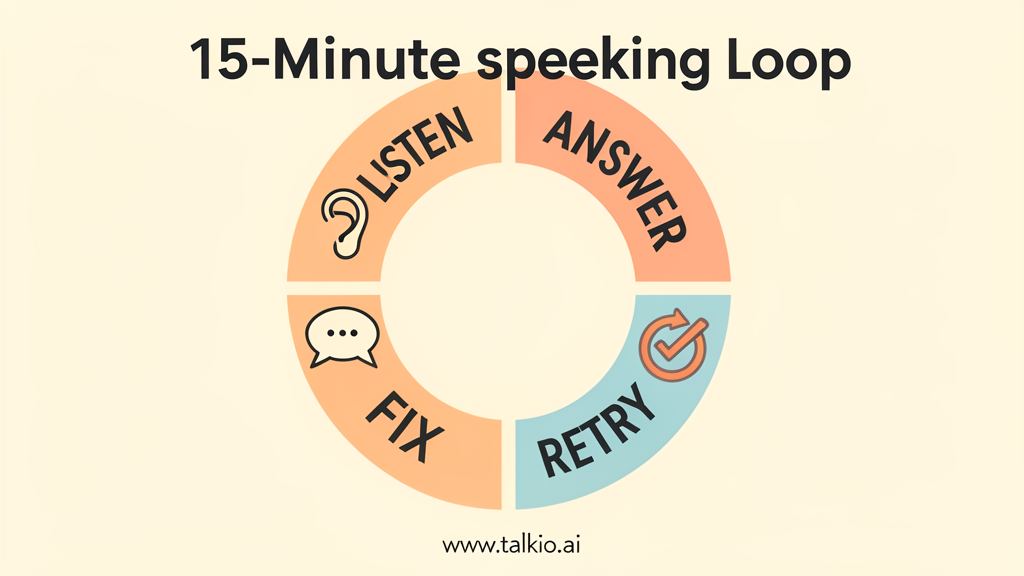
The 15-minute speaking loop: listen, answer, fix, retry
The loop is simple. You practice one tiny conversation situation, then repeat it with correction. The goal is not to cover many topics. The goal is to make one useful speaking pattern more automatic.
Step 1: Choose one real situation, not a broad topic
Do not say, “Let’s practice English.” That is too vague. Choose a scene you may actually face:
- checking into a hotel after a long flight
- explaining a work delay in a polite way
- asking a doctor to repeat something
- answering “Tell me about yourself” in a job interview
- ordering food when you have an allergy
If you are learning Spanish, you might start with a travel or cafe scene and then connect it to focused Spanish speaking practice with AI. If you are learning English for work, use workplace scenes from your own calendar.
Step 2: Listen to one prompt and answer without pausing too long
Ask your tutor, app, or AI partner to play the other person. Your job is to answer in 10–30 seconds. Short is fine. Imperfect is fine. Silence is the thing you are training against.
Example prompt:
“Your train was late and you arrive 20 minutes late to a meeting. Apologize and explain what happened.”
Your answer does not need to be fancy:
“I’m sorry I’m late. My train was delayed and I could not send a message. Thank you for waiting.”
This is where many learners discover the real gap. They may understand advanced grammar when reading, but simple spoken sentences are hard to produce quickly. That is the same output gap discussed in why you can read a language but still cannot speak it.
Step 3: Get one correction, not ten
Too much correction can make speaking feel like a test. Too little correction lets the same mistake survive forever. The sweet spot is one useful fix per round.
Ask for feedback in this format:
- What was clear?
- What was the biggest mistake or unnatural phrase?
- Give me one better version I can say next time.
This mirrors the value of timely correction. Talkio has written before about why real-time correction can help speaking practice. The point is not to interrupt every sentence. The point is to correct while the sentence is still fresh in your mind.
Step 4: Retry immediately with the correction
This is the step learners skip. They nod, save the correction, and move on. But the brain needs a second attempt.
Say the corrected version out loud. Then answer a slightly different prompt using the same pattern:
- “Your bus was canceled. Explain and apologize.”
- “Your internet stopped working before a video call. Explain and suggest a new time.”
- “You forgot to send a document. Apologize and say when you will send it.”
Now you are not just memorizing one line. You are building a reusable speaking move.
A practical 15-minute plan you can use today
Use this checklist. Set a timer. Stop when the time is up, even if it feels unfinished. Short daily loops beat rare marathon sessions.
The 15-minute checklist
- Minute 0–2: Pick the scene. Choose one real situation from travel, work, study, exams, or daily life.
- Minute 2–4: Warm up with one shadowing line. Copy one model sentence for rhythm and pronunciation.
- Minute 4–8: First conversation round. Answer 2–3 prompts without writing your response first.
- Minute 8–10: Correction round. Ask for one main correction and one better phrase.
- Minute 10–13: Retry round. Use the corrected phrase in 2 new prompts.
- Minute 13–15: Save one phrase. Write down the best sentence you want to reuse tomorrow.
If pronunciation is your main goal, start with a tongue-twister or sound drill, then move into the loop. Talkio’s guide to fun tongue twisters for pronunciation is a useful warm-up source, but the speaking loop is where you turn sound practice into usable conversation.
Why this works better than another hour of passive input
Listening and reading are important. Nobody speaks well without input. But input alone can give learners a false sense of progress. You recognize words, so you feel ready. Then a real conversation starts and your mouth cannot keep up.
The 15-minute loop adds the missing pressure in a safe way:
- Time pressure: You answer now, not after writing a perfect sentence.
- Meaning pressure: You respond to a situation, not just repeat audio.
- Feedback pressure: You hear what needs to change.
- Retry pressure: You use the correction before you forget it.
This is why conversation rehearsal matters for professionals, students, and travelers. If you have a meeting tomorrow, read Talkio’s last-minute English meeting warm-up and run the loop with your actual meeting topic.
What to say to your AI tutor
You do not need a complicated prompt. In fact, simple instructions usually work better. Copy this:
“Act as a friendly conversation partner. Give me one realistic prompt at a time for [situation]. Let me answer in simple [language]. After each answer, give one correction and one more natural version. Then ask a slightly different follow-up so I can try again.”
For example:
“Act as a friendly conversation partner. Give me one realistic prompt at a time for checking into a hotel in Spanish. Let me answer in simple Spanish. After each answer, give one correction and one more natural version. Then ask a slightly different follow-up so I can try again.”
If grammar keeps blocking you, use the same loop with one grammar target. Talkio’s guide on how to learn English grammar explains why grammar becomes more useful when you connect it to real use instead of only worksheets.
Common mistakes that make speaking practice weaker
Mistake 1: Practicing topics instead of moments
“Business English” is not a speaking task. “Ask your manager to clarify a deadline” is. Smaller moments create better practice.
Mistake 2: Asking for every correction
If you ask for ten corrections, you will remember none. Ask for the correction that would make your message clearer or more natural.
Mistake 3: Not repeating the corrected sentence
Correction without retry is just information. Correction plus retry becomes skill.
Mistake 4: Staying at the same difficulty
Once a scene feels easy, add a twist: background noise, a time limit, a confused listener, a follow-up question, or a more formal tone.
How to adjust the loop for different goals
For travel
Use concrete tasks: airport baggage desk, hotel check-in, restaurant allergy, taxi direction, pharmacy question. Link your practice to the language you need, such as Spanish, French, or German.
For work
Practice short professional moves: disagree politely, ask for clarification, summarize a decision, explain a delay, or open a presentation. The CEFR framework is a helpful reminder that real language ability is about what you can do in situations, not only which grammar points you know.
For exams
Use timed answers and a clear scoring focus: fluency, pronunciation, vocabulary, or task completion. If you are preparing for IELTS or TOEFL, add a final 30-second retry after correction. That quick second attempt is often where your best sentence appears.
For pronunciation
Begin with shadowing, then force the sound into your own answer. If you only repeat someone else’s sentence, the sound may not survive when you create your own sentence.
A simple progress test after seven days
After one week, do not ask, “Did I learn a lot?” Ask these five questions:
- Can I answer faster than last week?
- Do I use fewer filler sounds when surprised?
- Can I repair one mistake without switching to my native language?
- Do I remember 3–5 reusable phrases?
- Can I handle a follow-up question in the same scene?
If the answer is yes to even two of these, your speaking practice is becoming more real.
The small shift that changes everything
Keep shadowing. Use it as a warm-up. Use it when your mouth needs rhythm. Use it when a sound feels strange.
But do not stop there.
The learner who improves fastest is not the one who repeats the most perfect audio. It is the one who answers, gets corrected, and answers again. Fifteen focused minutes can do more for your speaking than an hour of comfortable review, because it trains the exact moment that matters: when you have to speak before you feel ready.
If you want structured practice for that moment, try a real conversation scene in Talkio and run the loop: listen, answer, fix, retry.
Talk Your Way
to Fluency
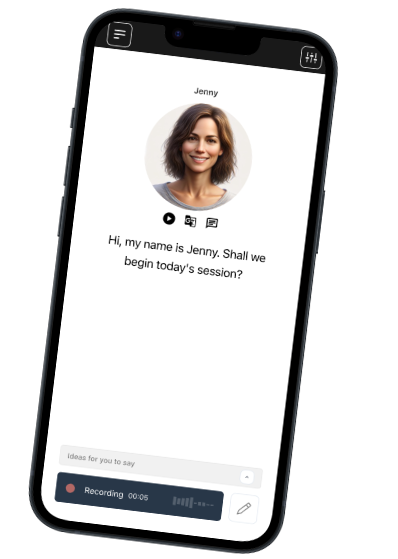
Talkio is the ultimate language training app that uses AI technology to help you improve your oral language skills!
Try Talkio