You Have a Meeting in English Tomorrow: A Last-Minute Speaking Warm-Up That Actually Works
Last updated on
Editorial owner: Taylor Freeman · Editorial policy
Your calendar notification just popped up. Tomorrow morning, you have a team meeting, a client call, or a project review, and it is happening in English. Your stomach drops a little. You know the vocabulary. You have read the emails. But when it is time to actually speak, something happens: your sentences come out choppy, you forget basic words, and you end up nodding along instead of contributing.
If this sounds familiar, you are not alone. Research published in the Asian-Pacific Journal of Second and Foreign Language Education found that AI-integrated speaking practice significantly improved vocabulary recall, pronunciation, and confidence in professional contexts. The key takeaway? Even short, focused speaking sessions before high-stakes moments can make a measurable difference.
Here is a practical warm-up routine you can use the evening before, or even the morning of, your next English-language meeting.
Why Your Brain Freezes in English Meetings
Before jumping into the fix, it helps to understand why this happens. When you communicate in your second language under pressure, your brain is doing double duty: processing the conversation content while simultaneously searching for the right words and grammar structures. Linguists call this cognitive load, and it spikes dramatically in real-time professional settings.
The problem is not your English level. It is that your spoken English has not been “warmed up.” Think of it like an athlete stretching before a race. Your passive English (reading emails, understanding colleagues) might be excellent, but your active speaking muscles need activation. This is exactly why you can understand everything but freeze when it is your turn to talk.
The 30-Minute Meeting Warm-Up
This routine is designed for the night before or morning of an important English meeting. It takes about 30 minutes and targets the exact skills you will need: fluency under time pressure, professional vocabulary recall, and the confidence to jump into a conversation without overthinking.
Step 1: Review the Agenda Out Loud (5 Minutes)
Pull up tomorrow’s meeting agenda or the email thread about the topic. Now, instead of just reading it silently, summarize each point out loud in your own words. Do not aim for perfection. Aim for flow.
Say things like: “So the first thing we need to discuss is the Q1 results, and I think the main issue is that we are behind on the European market.” Speaking the content aloud, even to yourself, primes your brain to retrieve those words faster when you need them in the actual meeting.
Step 2: Practice Your Key Contributions (10 Minutes)
Think about what you specifically need to say in this meeting. Do you have an update to give? A question to raise? An opinion on a decision?
Write down 2-3 bullet points, then practice saying each one naturally. Time yourself: can you deliver each point in under 60 seconds? In meetings, concise speakers get heard. Rambling speakers get tuned out, regardless of language.
This is where an AI-powered language training platform becomes genuinely useful. Instead of talking to your mirror, you can practice with an AI conversation partner that responds naturally, asks follow-up questions, and gives you real-time feedback on pronunciation and clarity.
Step 3: Simulate the Hard Parts (10 Minutes)
Every meeting has moments that catch non-native speakers off guard: being asked an unexpected question, needing to politely disagree, or explaining something complex on the spot. These are the moments where preparation pays off the most.
Practice handling curveballs. Have a conversation partner (human or AI) throw random meeting scenarios at you:
- “Can you walk us through the timeline for this?”
- “I disagree with that approach. What is your reasoning?”
- “We are running short on time. Can you summarize your point?”
The goal is not to memorize answers. It is to get your brain comfortable switching gears quickly in English. According to a 2023 study in Language Teaching Research, learners who practiced spontaneous speaking tasks showed significantly better fluency in subsequent unscripted conversations.
Step 4: Pronunciation Spot-Check (5 Minutes)
Every professional field has words that are surprisingly tricky to pronounce. “Analytics,” “infrastructure,” “preliminary,” “revenue,” these are words you might write confidently but stumble over when speaking quickly.
Make a short list of 5-10 field-specific words you will likely use tomorrow. Say each one clearly three times. If you are unsure about pronunciation, tools like AI pronunciation coaching can flag exactly where your stress patterns or vowel sounds need adjustment.
Meeting-Day Micro Habits
The warm-up the night before does the heavy lifting. But on the morning of your meeting, a few small habits can keep you sharp:
Listen to English for 15 minutes before the meeting. A podcast, a YouTube video, a news clip, anything in English. This switches your brain into “English mode” and makes the transition into the meeting smoother. Your brain needs time to activate its second-language processing pathways.
Arrive early and make small talk in English. Even saying “Hey, how is your morning going?” before the meeting starts warms up your speaking. It is low stakes and high reward.
Keep a “rescue phrases” note open. Write down 3-4 phrases you can glance at if you get stuck:
- “Could you repeat that? I want to make sure I understand.”
- “Let me think about that for a moment.”
- “To summarize what I am hearing…”
- “I would like to add something to that point.”
These are not crutches. They are tools that even native speakers use to buy thinking time and steer conversations.
Why This Works Better Than “Just Practice More”
Generic advice like “practice speaking every day” is technically correct but practically useless when you have a meeting in 12 hours. What makes this warm-up effective is specificity: you are practicing the exact words, scenarios, and pressure conditions you will face tomorrow.
This is also why AI conversation partners have become so popular for professional language practice. Unlike a language exchange app where you chat about hobbies, platforms like Talkio AI let you set up a specific scenario, say, a project status update or a salary negotiation, and practice it repeatedly with real-time feedback. It is the difference between going for a jog and doing sport-specific drills.
The bilingual bonus in the workplace is real, with multilingual workers earning significantly more on average, but that bonus only materializes when you can actually perform under pressure, not just list your language skills on a resume.
Building Long-Term Meeting Confidence
The warm-up routine above is designed for immediate results. But if English meetings are a regular part of your work life, the real goal is to make this level of fluency your baseline, not something you have to cram for.
The most effective approach, according to research from Cambridge’s Annual Review of Applied Linguistics, is consistent, short speaking sessions focused on real-world tasks. Fifteen minutes of targeted speaking practice three times a week builds more professional fluency than hours of grammar study or vocabulary apps.
The professionals who speak confidently in English meetings are not necessarily the ones with the biggest vocabulary. They are the ones who practiced speaking out loud, in realistic scenarios, often enough that it became automatic. And with AI conversation tools available around the clock, the barrier to getting that practice has never been lower.
Your meeting is tomorrow. You have 30 minutes tonight. That is more than enough.
Talk Your Way
to Fluency
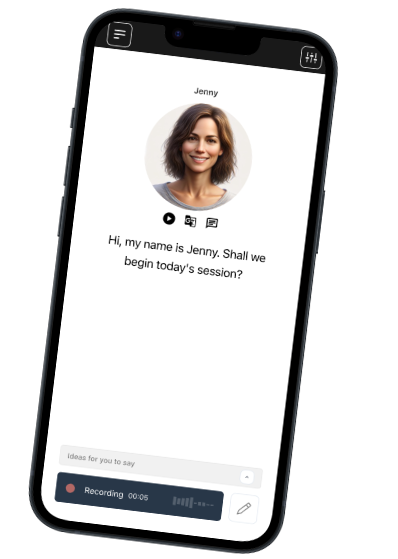
Talkio is the ultimate language training app that uses AI technology to help you improve your oral language skills!
Try Talkio