How Pattern Recognition Helps Language Learning—and Where AI Differs
Last updated on
Editorial owner: Taylor Freeman · Editorial policy
Human learners and language AI can both become sensitive to patterns in large amounts of language, but that similarity should not be stretched too far. People learn through bodies, goals, relationships, memory, and real-world meaning; an AI model learns statistical relationships in data. The practical lesson is narrower and useful: repeated, meaningful examples help you predict what comes next and retrieve language more efficiently.
Use patterns without turning practice into imitation
- Collect several natural examples of one phrase or grammar pattern.
- Predict the missing word or ending before checking the original.
- Create a new sentence connected to your own life or purpose.
- Use the pattern in conversation and verify surprising AI-generated corrections before memorizing them.
New Research Shows Your Brain Learns Languages the Same Way AI Does
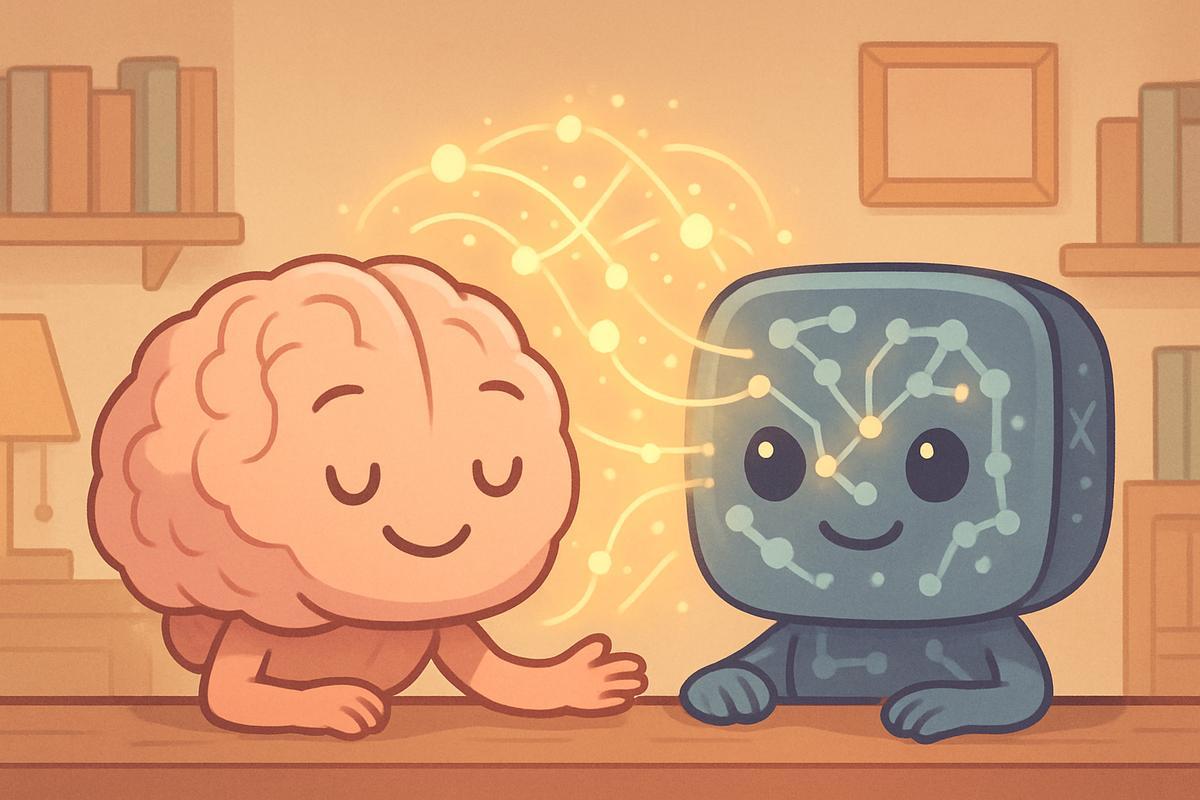
A groundbreaking study published in early 2026 made waves across the neuroscience community: the human brain processes spoken language in a step-by-step sequence that closely mirrors how large language models (LLMs) work. Researchers at the Hebrew University used electrocorticography recordings to track brain activity in real time, and what they found was striking. Your brain doesn’t just “understand” language all at once. It builds meaning in layers, from raw sounds to words to context, exactly the way an AI model processes text through its neural network.
For anyone learning a new language, this isn’t just a cool science fact. It fundamentally changes how you should think about your study routine.
What the Research Actually Found
The study, which built on earlier work from MIT’s McGovern Institute, showed that early neural signals in the brain matched the early processing stages of AI models, while deeper brain responses aligned with the later, more complex layers. In plain terms: your brain predicts the next word in a sentence the same way ChatGPT does. It takes sounds, builds probable word candidates, checks them against context, and refines meaning as more information arrives.
This “predictive processing” model of language isn’t entirely new, but the strength of the parallel with AI architecture is. Google Research confirmed similar findings in their own collaboration with Princeton and NYU, showing that deep language model embeddings can effectively predict human brain responses during natural conversation.
The takeaway? Language learning isn’t about memorizing rules and vocabulary lists. It’s about training your brain’s prediction engine.
Why This Matters for Language Learners
If your brain processes language through prediction and pattern recognition, then the most effective way to learn is to give it massive amounts of patterned input, ideally through real conversation. Think about how AI models are trained: they don’t study grammar textbooks. They process billions of examples of real language until patterns emerge naturally.
Your brain wants to do the same thing. When you practice speaking regularly, you’re not just building muscle memory for pronunciation. You’re training your brain’s predictive model, strengthening the neural pathways that anticipate what comes next in a sentence.
This explains a phenomenon every language learner knows: the person who moves abroad and stumbles through daily conversations for three months will usually outperform someone who studied grammar for a year. The conversational learner fed their brain’s prediction engine with real, contextual input. The grammar student gave it disconnected rules.
The Prediction Gap: Why You Understand but Can’t Speak
One of the most frustrating experiences in language learning is understanding everything someone says to you but freezing when it’s your turn to respond. The neuroscience explains this perfectly. Your brain has developed strong receptive prediction models (it can anticipate what’s coming in speech it hears), but the productive prediction pathways are undertrained.
When you listen to a podcast or watch a show in your target language, you’re training one side of the prediction engine. To train the other side, you need to actually produce language, making predictions about which words to say next, in real time, under the mild pressure of a conversation.
This is why speaking practice matters so much more than most learners realize. It’s not just about fluency or confidence. It’s about building the specific neural prediction pathways that only activate during speech production.
How AI Conversation Partners Train Your Brain’s Prediction Engine
Here’s where things get interesting. If your brain learns language like an AI, then practicing with an AI conversation partner creates a unique feedback loop. You’re essentially using one prediction engine (the AI) to train another (your brain).
The advantages are practical. An AI partner is endlessly patient, available at any hour, and can adjust its complexity to match your level. But the neuroscience adds another layer: AI conversation partners can provide the kind of consistent, varied, contextual input that your brain’s prediction model craves. Unlike a textbook that presents the same sentences in the same order, a conversation is unpredictable by nature. Every exchange forces your brain to make new predictions, strengthening the neural pathways that matter most.
Platforms like Talkio are designed around this principle. Rather than drilling vocabulary or testing grammar rules, conversation-based practice feeds your brain exactly what it needs: real, contextual, unpredictable language that forces active prediction.
Five Ways to Train Your Brain’s Language Prediction Engine
Based on what we now know about how the brain processes language, here are practical strategies that align with the science:
1. Prioritize speaking over studying. Every minute spent in conversation trains your productive prediction pathways. Even if you stumble and make mistakes, the act of trying to predict the right word in real time is exactly the workout your brain needs.
2. Vary your conversation topics. AI models improve by processing diverse data, and your brain is no different. Don’t just practice ordering coffee. Talk about your weekend plans, debate a news story, describe a movie you watched. The wider the range, the stronger your prediction model becomes.
3. Embrace the discomfort of not knowing. When your brain encounters a word it can’t predict, that’s not failure. That’s learning. Those moments of confusion are when your neural prediction model is actively updating, creating new pathways for future conversations.
4. Listen actively, then respond. Passive listening (having a podcast on in the background) is far less effective than active listening followed by a response. When you know you’ll need to reply, your brain engages its prediction engine at full capacity, processing not just meaning but also planning its own output.
5. Practice daily in short bursts. Research on AI-powered language training platforms consistently shows that frequent, shorter sessions outperform occasional long ones. Your brain’s prediction model improves through repetition and consistency, not marathon sessions. If you need a concrete weekly structure, adapt the 15-30-15 language-learning schedule to your available time.
The Future of Language Learning Is Already in Your Head
The irony of this research is that AI didn’t teach us something new about language learning. It gave us the tools to see what our brains were doing all along. For decades, language education focused on rules, conjugation tables, and vocabulary lists. The neuroscience now confirms what immersion advocates have argued for years: your brain learns language through prediction and pattern recognition, not memorization.
The practical implication is simple. If you want to learn a language effectively, stop studying it like an exam subject and start using it like a tool. Have conversations, even imperfect ones. Let your brain’s prediction engine do what it was built to do. The latest AI research suggests your brain is already wired for this. You just need to give it the right input.
Whether you practice with a friend, a tutor, or an AI conversation partner, the message from neuroscience is clear: speak more, study less, and trust your brain to find the patterns.
Talk Your Way
to Fluency
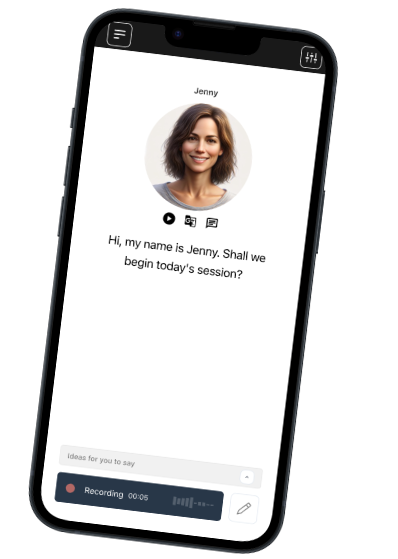
Talkio is the ultimate language training app that uses AI technology to help you improve your oral language skills!
Try Talkio