What Is an AI Language Learning Platform? Features and Questions
Last updated on
Editorial owner: Taylor Freeman · Editorial policy
An AI language learning platform uses technologies such as speech recognition and language models to respond to learners, generate practice, and provide feedback. The category includes very different products, so the label alone says little about quality. A useful evaluation starts with the skill you want to improve and tests whether the platform produces meaningful practice for that skill.
What to evaluate before you subscribe
- Speaking depth: does the system follow an open response or only accept a fixed sentence?
- Feedback: is it specific, understandable, and usable in the next attempt?
- Control: can you select language, level, goal, scenario, pace, and variety where relevant?
- Progress: can you review past practice and distinguish activity from actual skill development?
- Trust: are pricing, cancellation, device access, privacy, and AI limitations explained clearly?
Takeaways:
- Clarify how an AI-powered language training platform shifts language learning from memorization to practical speaking use.
- Break down the technologies that enable AI language training and how they function during real conversations.
- Trace the flow of an AI-driven practice session – from first response to adaptive feedback over time.
- Weigh the strengths and limits of AI language learning alongside traditional and human-led methods.
- Assess how to identify effective AI language tools using clear criteria tied to speaking performance and progress.
Just a thought: at least part of our lives, we wish to learn a language at our own pace, live the process affordably and easily, and visit places to have a dialogue with locals.
This type of experience has prompted aspiring language learners to seek more practical ways to build language confidence – with a focus on human-like or simulated conversation, speaking practice, and can be accessed immediately.
On the contrary, as observed, traditional language-learning methods often fall short when consistency and real-time correction are missing.
This speaking gap is exactly where AI-powered language training platforms step in – offering structured and articulated AI speaking practice without scheduling barriers.
Advances in speech recognition, natural language understanding, and conversational AI have finally made realistic language practice possible.
Instead of memorizing rules, learners can now train how they actually speak conveniently – marking a clear shift toward modern AI language education designed for real use.
In this article, you will learn why an AI-powered tool paved its way to the contemporary approaches to learning language.
What an AI-Powered Language Training Platform Really Is
Let’s first define an AI-powered language training platform. According to AbsorbLMS, it is an online learning system that applies artificial intelligence technologies such as machine learning (ML) and natural language processing (NLP) to improve how you learn and practice a language.
Unlike traditional learning management systems, this AI language training uses data and algorithms to adapt in real time, making informed adjustments to support your individual speaking development.
This form of AI language training is designed to help you practice speaking in conditions that reflect how language is actually used.
Rather than relying on memorization alone…you learn through interaction.
With conversational AI language practice, the platform analyzes what you say, how you say it, and how your responses evolve.
Each exchange delivers focused AI speaking practice, allowing feedback to align with your current ability instead of a fixed curriculum.
By concentrating on real spoken performance, AI language learning helps transform knowledge into usable communication skills that carry into everyday and professional conversations.
The Technology That Enables AI Language Training
What you experience when using AI language to learn is the result of multiple technologies working together and integrated so profoundly to analyze, respond, and guide your speaking in real time.
Speech Recognition and Voice Analysis
This captures your spoken input the instant you converse with the language tool…converting sound into structured data that the system can process.
It allows the platform to examine:
- pronunciation accuracy,
- speech clarity,
- rhythm, and
- pacing with precision.
Recurring analysis facilitates improving your AI speaking practice by identifying patterns that affect how natural and understandable you may sound over time.
NLPA (a.k.a. Natural Language Processing)
It is the AI capability that allows systems to interpret human language by analyzing:
- grammar,
- sentence structure, and
- meaning in context.
This evaluates what your sentences express rather than relying on rigid rules alone.
By separating acceptable variation from true errors, NLP supports practical AI language training aligned with real communication.
Conversational AI Systems
This operates by combining speech analysis and NLP to generate context-aware responses and manage dialogue flow.
Instead of scripted replies, the system follows up naturally, maintaining continuity across turns.
This creates sustained conversational AI language practice that mirrors how real conversations develop.
Together, these technologies transform spoken input into targeted guidance…turning everyday practice into measurable communication progress.
What Actually Happens During an AI-Driven Practice Session
You should know how an AI-powered language training platform supports your speaking, if not linguistic development, during real use with clarity and purpose.
To begin, each session opens with a speaking prompt aligned to your level, learning history, and goals.
You respond aloud, triggering AI speaking practice that captures not just your words but how you deliver them.
Pronunciation, pacing, and sentence structure are analyzed instantly…setting a clear baseline for focused AI language learning.
Next, feedback appears within moments while the interaction is still fresh in your mind.
You’re shown where pronunciation drifted, which phrases sounded unnatural, and how adjustments could improve clarity.
This “practice-feedback-retry” cycle keeps AI language training active and responsive – allowing you to correct and repeat without interruption.
Lastly, the system adapts as it learns from your behavior over time.
Patterns in your speech guide future prompts, difficulty levels, and conversational depth.
As a result, conversational AI language practice evolves with you – reflecting how your real speaking ability develops rather than following a fixed path.
Core Capabilities of AI-Powered Language Training Platforms
Choosing a platform means knowing exactly which capabilities will support your speaking progress and how they translate into your daily practice.
- Real-Time Speaking Feedback
- Receive immediate corrections while your response is still fresh
- See specific notes on clarity, word choice, and sentence flow
- Retry instantly to reinforce correct AI speaking practice
- Reduce repeated errors through consistent AI language learning
- Pronunciation and Fluency Insights
- Identify sounds that interrupt understanding
- Track pacing, pauses, and speech rhythm over time
- Compare delivery against natural speech patterns
- Improve intelligibility through targeted AI language training
- Vocabulary Usage Support
- Learn which words fit specific contexts more naturally
- Replace direct translations with functional phrasing
- Practice recall during conversational AI language practice
- Strengthen usable vocabulary – instead of memorized lists
- Personalized Learning Paths
- Adjust difficulty based on real speaking performance
- Focus sessions on weak areas automatically
- Progress without fixed lesson constraints
- Stay aligned with personal and professional goals
- Progress Visibility and Performance Tracking
- Monitor speaking improvement through clear indicators
- Review feedback trends across sessions
- Measure communication growth, not lesson completion
- Maintain accountability with transparent AI language learning data
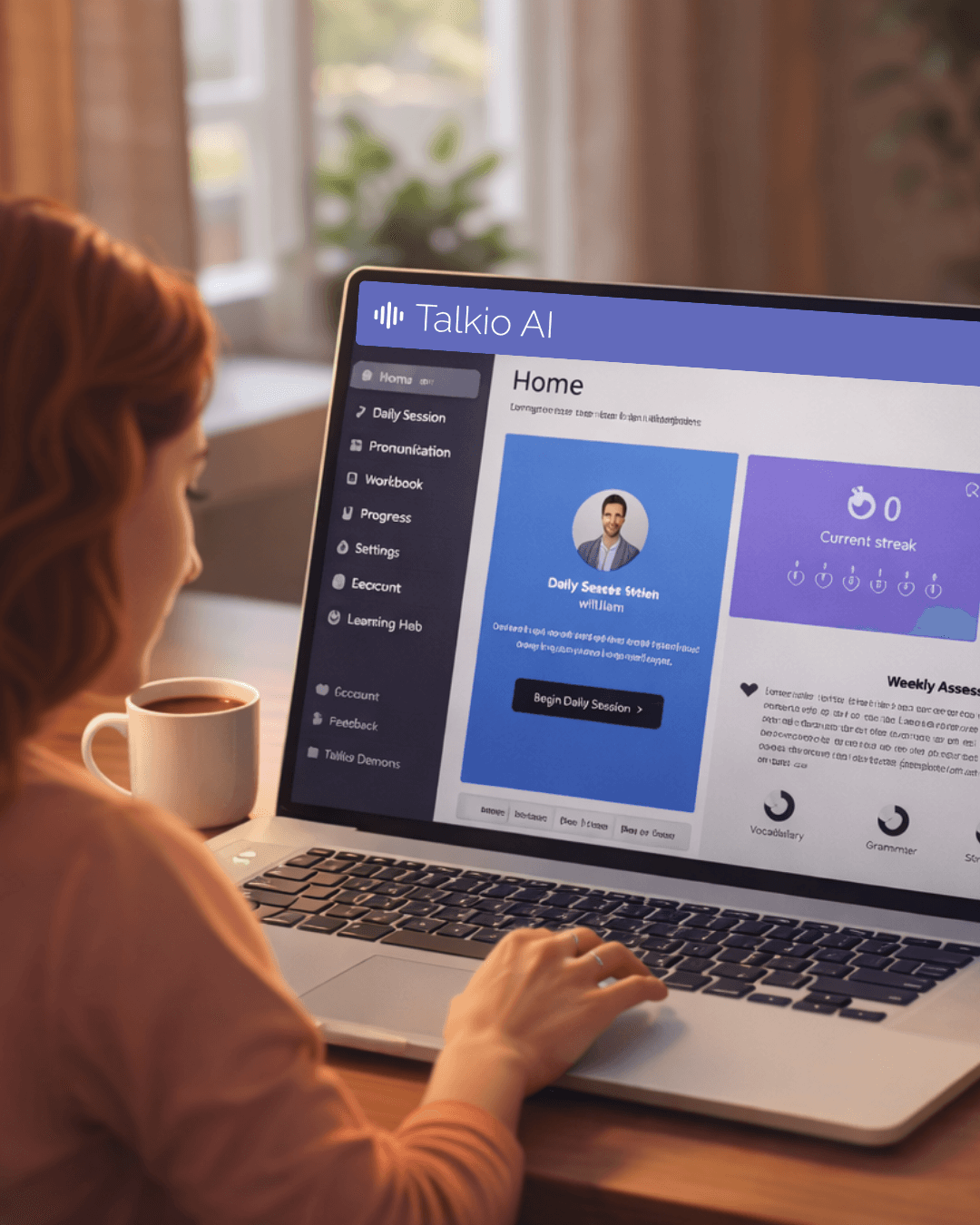
Platforms such as Talkio integrate these capabilities into a single experience…allowing your speaking ability to develop through consistent practice rather than isolated study.
Strengths of AI-Powered Language Training
The strengths of an AI-powered language training platform become clear when you compare how easily and consistently you can practice speaking – compared to traditional options.
| Learning Strength | What This Means for You | Practical Impact |
| Practice without scheduling barriers | You practice speaking anytime without coordinating with tutors or classmates | AI language learning fits into real routines, not fixed calendars |
| Low-pressure speaking environment | You speak freely without fear of judgment or interruption | Confidence grows through stress-free AI speaking practice |
| Immediate, repeatable feedback | Corrections appear instantly and can be applied right away | AI language training reinforces improvement through repetition |
| Exposure to diverse accents and styles | You hear and respond to varied speech patterns and tones | Conversational AI language practice prepares you for real-world communication |
Highlight these strengths to demonstrate how AI-based speaking practice supports steady progress by simply removing common obstacles that limit how often and how confidently learners speak.
Limitations Learners Should Understand
An AI language tool is highly effective for structured speaking practice…but certain limits are important to recognize as you progress; do not forget that.
While AI language learning can assess pronunciation and sentence structure – it struggles with emotional nuance.
Tone shifts driven by humor, sarcasm, or personal intent are often interpreted literally, which affects how feedback is framed during AI speaking practice.
Cultural context also presents challenges that might take some time before the said AI can integrate it into its programs.
Social norms, situational politeness, and unspoken expectations vary widely, and AI language training cannot always account for these subtleties during interaction.
For this reason, AI works best as a support tool – yet.
Conversational AI language practice strengthens fluency and confidence…all the while real human interaction remains critical for deeper cultural and emotional understanding.
How AI Language Training Compares to Traditional Methods
Identifying how an AI-powered language tool significantly compares with traditional options helps you determine whether this fits in your learning routine.
AI Platforms vs. Classroom Learning
It places control back in your hands. You practice speaking at your own pace, repeat difficult moments, and focus on personal gaps rather than following a group schedule.
While classrooms support discussion and peer exposure…AI language learning provides individualized AI speaking practice without waiting for shared progress or limited speaking turns.
AI Platforms vs. Human Tutors
It changes how access and consistency shape your progress.
A tutor offers human nuance, but availability, cost, and scheduling? They often limit frequency.
On the other side of the coin, AI language training delivers an on-demand session with stable feedback – allowing conversational AI language practice whenever your schedule permits.
Used together or independently, these methods serve different needs – with AI filling gaps where consistency and access matter most.
While it is fun to compare AI Tutor vs. Traditional Teaching, let’s keep in mind that they’re better if they are aligned together.
Learners Who Gain the Most From AI-Based Practice
AI-powered language training platform tends to benefit learners with specific needs and constraints, such as:
- Independent learners who manage their own schedules benefit from consistent AI language learning without relying on external availability.
Self-paced AI speaking practice allows them to focus on personal goals and repeat sessions as needed.
- Professionals improving workplace communication use AI language training to practice:
- presentations,
- meetings, and
- everyday interactions in a controlled setting.
Targeted feedback supports clarity and confidence before real conversations happen.
- Students supplementing formal education rely on conversational AI language practice to increase speaking time beyond the classroom.
This extra exposure reinforces lessons…all the while reducing performance pressure.
- Educators or teachers use AI language training to demonstrate speaking models – creating practice opportunities for learners and supplement limited classroom speaking time.
The built-in AI speaking can act as an extension to instructions beyond live sessions while maintaining consistent feedback.
These individuals see the greatest impact when structured speaking practice and timely feedback are built into their daily routines and you could be one of them, if you try.
How AI Language Training Fits, Grows, and Should Be Judged
If you’re using or considering an AI-powered language training platform…keep in mind to perceive it could connect in real educational and professional settings by:
| Learning Context | Role of AI | How It Evolves | How to Evaluate |
| Individual growth | Builds steady AI language learning through daily speaking routines | Builds steady AI language learning through daily speaking routines | 1) Do a 5-minute baseline AI speaking practice session. 2) Check if feedback is specific (sounds, pacing, phrasing). 3) Repeat the same prompt after corrections. 4) Confirm the platform updates your next prompt difficulty based on performance. |
| Classrooms | Adds extra speaking time beyond limited class turns | Adds extra speaking time beyond limited class turns | 1) Test one classroom topic prompt. 2) Check if instructions match student level. 3) Review whether feedback is easy to act on. 4) Verify progress tracking works per student over time. |
| Workplace training | Rehearses meetings, presentations, and role-based conversations | More natural, job-relevant dialogue and follow-ups | 1) Run a role-play (meeting update / customer call). 2) Confirm the AI follows context instead of switching topics. 3) Review clarity feedback on tone and phrasing. 4) Track improvements across repeated work scenarios. |
| Educators | Acts as a scalable practice partner for guided homework | Learns from learner data to refine personalization | 1) Assign the same prompt to a small group. 2) Compare feedback consistency across learners. 3) Check teacher visibility into results. 4) Confirm it highlights common class-wide issues. |
| Organizations | Standardizes AI language training across teams and locations | Better personalization from aggregated training data | 1) Pilot with 2–3 teams using identical goals. 2) Audit whether scoring is consistent across locations. 3) Check language/accent support for your workforce. 4) Confirm reporting is transparent and exportable. |
| Global learners | Offers access where live speaking partners are scarce | Broader language coverage and improved accent handling | 1) Test your target accent and common phrases. 2) Confirm the AI understands varied pronunciation. 3) Verify feedback stays accurate across multiple sessions. 4) Check that prompts reflect real-life situations you face. |
These contexts show how AI’s impact depends not only on capability – but on thoughtful integration and clear evaluation standards.
Closing Thoughts
An AI-powered language training platform brings together
- speaking practice,
- real-time feedback,
- personalization, and
- progress tracking into a single learning experience.
As explored throughout this article, AI language learning focuses on how you actually communicate – supporting consistent AI speaking practice, adaptive improvement, and practical skill use.
These platforms matter today because they remove:
- common barriers to access,
- time, and
- feedback while complementing – rather than replacing – human interaction.
As AI language training continues to improve and adapt to the its demand…choosing tools that prioritize clarity, interaction quality, and measurable progress becomes increasingly important.
Across of these talks, Talkio AI reflects these principles by combining conversational practice with data-driven guidance designed for real-world communication.
Ready to use Talkio now?
Try Talkio free for 7 days and experience fun and guided speaking practice with immediate feedback – no setup or scheduling required.
Know someone who would use Talkio?
Invite them through our Affiliate Program and earn rewards for sharing a smarter way to practice language.
Talk Your Way
to Fluency
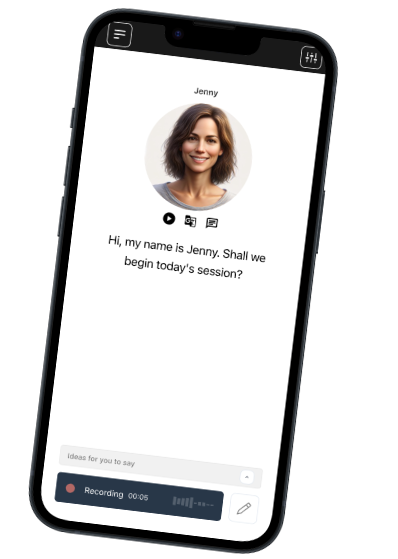
Talkio is the ultimate language training app that uses AI technology to help you improve your oral language skills!
Try Talkio