The Chunking Method: Learn Phrases Instead of Single Words
Last updated on
Editorial owner: Taylor Freeman · Editorial policy
You know hundreds of words. Then someone asks a simple question, and your mind starts assembling a sentence like flat-pack furniture: noun, verb, tense, preposition, panic.
The usual diagnosis is “I need more vocabulary.” Often, that is wrong. The real problem is that your vocabulary is stored as loose pieces instead of ready-to-use language chunks: short combinations such as “That depends on…”, “What I mean is…”, and “I’m not used to…”.
Here is the useful twist: fluent speakers do not create every sentence one word at a time. They lean on familiar patterns and adapt them. Once you start practising those patterns as spoken units, conversation becomes faster—even before you learn many new words.
What is a language chunk?
A language chunk is a group of words that frequently appears and functions as one usable unit. It can be:
- A collocation: make a decision, heavy traffic, strong opinion
- A sentence frame: The main reason is…, I’d rather…, It depends on…
- A conversation tool: Let me think, How about you?, Could you say that again?
- A situation-specific phrase: Could we move the meeting?, Is breakfast included?
This is not a shortcut around grammar. Chunks are grammar in action. If you can comfortably say “I’ve been meaning to…”, you are already using a complex verb pattern without stopping to calculate it.
Research on formulaic sequences in second-language teaching has long argued that these recurring combinations matter for both processing and fluent production. More recent work has connected formulaic language directly with second-language speech fluency. The practical lesson is simple: phrases deserve a place beside words in your study routine.
Why single-word study breaks down in conversation
Knowing a word and retrieving it inside live speech are different skills. During a conversation, your attention is divided. You are listening, reading the other person’s reaction, choosing an idea, checking grammar, and planning what comes next.
If every sentence must be built from separate words, the mental cost becomes high. That is one reason learners can read a language well but still struggle to speak it. Recognition is not the same as fast, flexible recall.
Chunks reduce the number of decisions. Instead of selecting five separate words, you retrieve one familiar pattern and fill one gap:
- One advantage is + flexible working hours.
- I’m not sure whether + the train stops there.
- The last time I + visited Madrid, it rained.
- Would you mind + speaking more slowly?
You are not memorising a script. You are building reusable scaffolding.
The chunk-to-speech loop
Most chunk study fails because learners collect phrases but never force them into speech. A better method has four stages: Notice, Save, Swap, Speak.
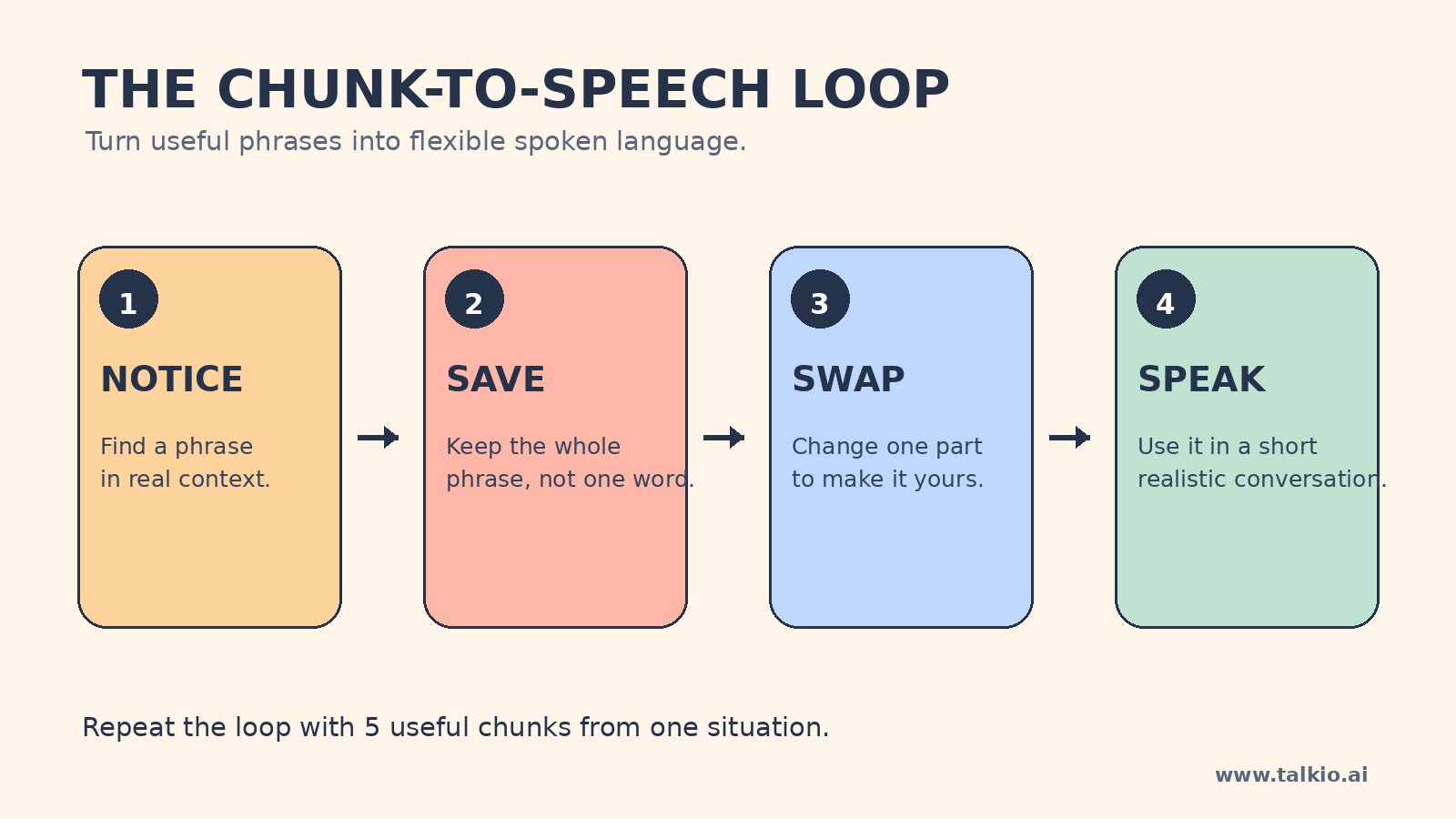
1. Notice a useful phrase in context
Choose phrases you can imagine using this week. A phrase from a meeting, podcast, lesson, email, or AI conversation is more valuable than an impressive expression with no clear situation.
Good candidates are:
- common enough to reuse;
- short enough to say in one breath;
- connected to a real speaking goal;
- slightly beyond what you already say automatically.
If you are learning American English, for example, begin with situations shown on the American English speaking practice page, not with random idioms.
2. Save the whole chunk, not the “new word”
Imagine you hear, “I ended up taking the later train.” Do not save only end. Save the working frame:
I ended up + -ing = the final, sometimes unexpected result.
Add one real example from your life: “I ended up cooking at home.” Personal examples are easier to retrieve because they carry a scene and a memory.
3. Swap one element
Keep the frame stable and change only one part:
- I ended up cooking at home.
- I ended up taking a taxi.
- I ended up working late.
- I ended up meeting her on Friday.
This “one-slot swap” is the bridge between repetition and flexible speech. You get enough repetition for the pattern to settle, but enough variation to prevent it from becoming a dead script.
4. Speak it inside a short conversation
Now create a reason to use the chunk. For “I ended up…”, practise telling a story about a plan that changed. For “Would you mind…”, role-play a hotel, workplace, or travel problem.
This is where an AI conversation partner can help. AI speaking practice is most useful when you ask for a focused scenario and repeat the target pattern naturally, not when you simply chat without a goal. If you are comparing tools, look for the features discussed in this guide to the best AI language speaking practice apps: real voice interaction, useful feedback, and enough flexibility to rehearse your own situations.
A practical 15-minute chunk workout
Use this routine with five chunks, three or four times per week.
- Choose (2 minutes): Pick five phrases from one situation, such as a job interview, restaurant visit, or weekly meeting.
- Listen and mark rhythm (3 minutes): Hear each phrase and mark the stressed words. Do not pronounce every word with equal force.
- Swap the slot (3 minutes): Make three personal variations of each phrase.
- Answer aloud (4 minutes): Respond to short questions that give you a reason to use the chunks.
- Review from memory (2 minutes): Hide your notes and say as many as you can.
- Choose tomorrow’s two (1 minute): Keep only the two phrases that still feel slow.
The rhythm step matters. Natural speech connects and reduces sounds, which is why written phrases can feel different when spoken. This guide to connected speech explains what happens when words meet in real conversation. For extra pronunciation play, the Talkio tongue-twister collection can help train clean transitions between difficult sounds.
Build chunk sets around situations, not grammar chapters
A grammar chapter might give you the conditional. A conversation gives you a purpose. Organise your chunks by purpose so your brain can find them when that situation returns.
For giving an opinion
- From my point of view…
- The way I see it…
- I agree up to a point, but…
- One concern I have is…
For buying time
- Let me think for a second.
- That’s a good question.
- How can I put this?
- What I’m trying to say is…
For checking meaning
- Do you mean…?
- So, if I understand correctly…
- Could you give me an example?
- When you say ___, what do you mean?
For telling a story
- It all started when…
- At first, I thought…
- It turned out that…
- In the end, we decided to…
You can use the free practice library from Cambridge English to find level-appropriate input, then extract only the phrases that fit your needs. The Council of Europe’s CEFR resources are also useful when you want to connect practice goals with real communicative abilities rather than a raw word count.
Five mistakes that make chunk practice useless
- Collecting too many. Ten active phrases beat 100 forgotten ones.
- Choosing decorative idioms. Learn “I’m running a little late” before a colourful expression you may use once a year.
- Reading silently. Speaking fluency requires spoken retrieval. Your mouth needs practice too.
- Repeating without variation. A memorised line may disappear when the topic changes. Swap one element every time.
- Ignoring feedback. If a phrase is grammatically correct but unnatural in that context, adjust it. Real-time correction is valuable when it targets a pattern you are actively trying to improve.
Also, do not confuse chunk practice with shadowing. Shadowing can sharpen rhythm and listening, but copying alone does not guarantee flexible speech. That is why a stronger routine moves from imitation to variation and then to conversation—a distinction explored in this 15-minute speaking loop.
Your seven-day chunk challenge
Choose one situation you are likely to face: introducing yourself, making small talk, checking into a hotel, joining a meeting, or explaining a problem. Then use this checklist:
- Day 1: Find eight useful chunks from reliable examples.
- Day 2: Record each chunk plus one personal variation.
- Day 3: Practise three one-slot swaps per chunk.
- Day 4: Use at least five chunks in a two-minute role-play.
- Day 5: Repeat the role-play with an unexpected question.
- Day 6: Listen to your recording and keep the four weakest chunks.
- Day 7: Do the conversation again without notes.
Your score is not the number of phrases you remembered. Ask instead:
- Did I begin answers faster?
- Did I pause in more natural places?
- Could I adapt the phrase when the question changed?
- Did I spend more attention on meaning and less on assembling grammar?
Words are ingredients; chunks are what you can actually serve
Vocabulary still matters. Grammar still matters. But conversation does not reward the person with the largest silent collection of either. It rewards fast access to useful language.
Start small: five chunks, one situation, fifteen minutes. Notice them, save them, swap one part, and speak them. When those phrases become automatic, your attention is finally free to do what conversation is for—listen, react, and say something worth hearing.
Talk Your Way
to Fluency
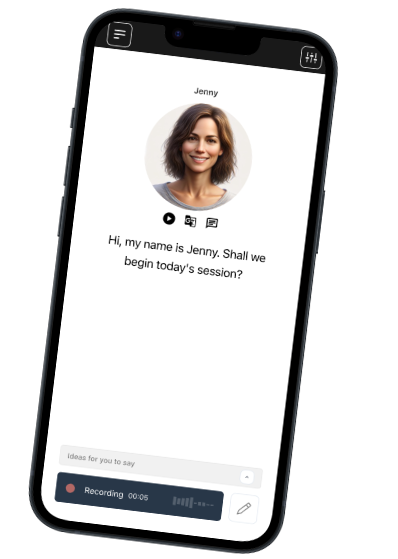
Talkio is the ultimate language training app that uses AI technology to help you improve your oral language skills!
Try Talkio