12 Conversation Repair Phrases for When You Don’t Understand
Last updated on
Editorial owner: Kier Lee Zamora · Editorial policy
You know the moment: someone says one fast sentence, you catch about 70 percent, and your mouth answers, “Yes, exactly.” Then the conversation moves on and you realize you agreed to something you did not understand.
Many language learners treat this as a vocabulary problem. Often it is not. The missing skill is conversation repair: noticing that meaning has broken down, asking for the right kind of help, checking the answer, and continuing without turning the exchange into an apology.
That skill matters more than sounding perfect. The CEFR Companion Volume treats asking for clarification and resolving misunderstandings as part of real communicative ability. In other words, “Could you say that another way?” is not evidence that your language failed. It is evidence that you know how conversation works.
Below are 12 practical conversation repair phrases, plus a simple drill for making them automatic. The most useful phrase is probably not the one you expect.
Why pretending to understand makes speaking harder
Nodding can save five seconds of embarrassment, but it creates three larger problems:
- You lose the next sentence too. Your attention stays stuck on the missing detail while the speaker continues.
- You teach yourself to escape. Every fake “yes” makes avoidance easier and recovery less familiar.
- You deny the other person useful information. A conversation is a shared task. Your partner cannot rephrase what they do not know you missed.
This is one reason learners can read comfortably yet struggle to respond in real time. The issue is not always knowledge; it is the output gap between recognition and live speech. Repair phrases create a small bridge across that gap. They buy time, narrow the problem, and give you another chance to process the message.

The four-step conversation repair loop
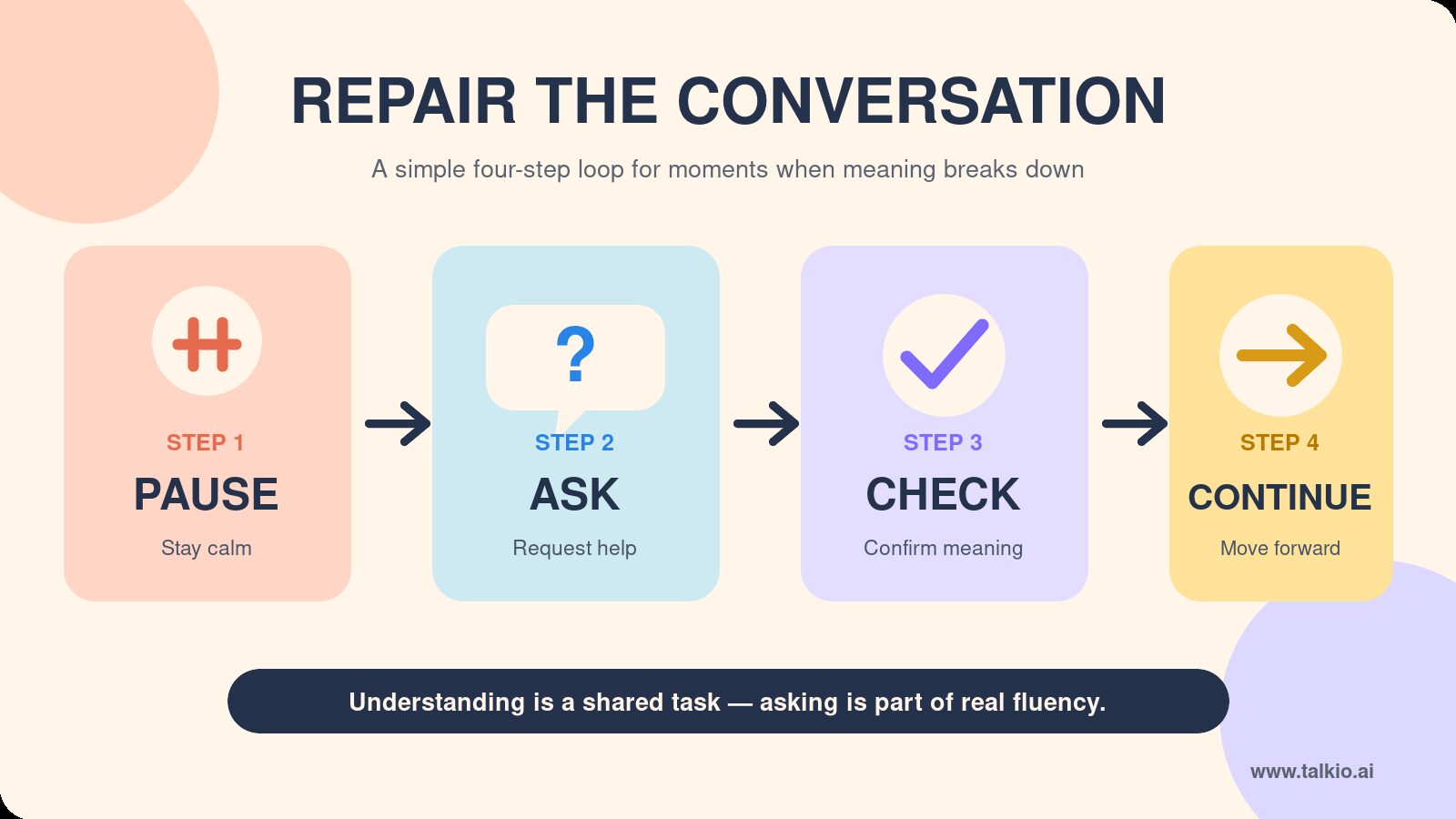
Good repair is short. You do not need a speech about being a beginner. Use this loop:
- Pause: stop the exchange before the missing detail becomes a missing paragraph.
- Ask: request one specific kind of help: repetition, slower speech, a definition, or a rephrased sentence.
- Check: say what you think you heard or understood.
- Continue: answer the original point and move on.
The goal is not to remove every misunderstanding. It is to recover quickly enough that the conversation stays alive. That is also why speaking practice should include interruptions and corrections, not just uninterrupted monologues. See our guide to real-time correction in AI speaking practice.
12 conversation repair phrases worth practicing
1. “Sorry, could you say that again?”
Use this when you missed the whole sentence. It is neutral, natural, and useful in nearly every setting.
2. “Could you say that a little more slowly?”
Use this when you recognize the words but cannot segment them fast enough. Ask for “a little” more slowly; it sounds like a practical adjustment, not a demand for exaggerated speech.
3. “I caught the first part, but not the last part.”
This is more efficient than requesting the entire sentence again. It also shows the speaker exactly where communication broke.
4. “What does ___ mean here?”
The word here matters. It asks about meaning in context rather than requesting a dictionary lecture. This is especially useful with phrasal verbs, slang, and workplace expressions.
5. “Do you mean ___?”
This is one of the strongest repair tools because it turns passive confusion into an active hypothesis. Even when your guess is wrong, the speaker now knows what to correct.
6. “So, if I understand correctly, ___?”
Use this for instructions, plans, or complicated opinions. It is particularly valuable in professional conversations where a false “yes” can create an expensive mistake.
7. “Could you give me an example?”
Definitions can be harder than the original word. One concrete example often makes the meaning obvious faster.
8. “Could you say that another way?”
This is the phrase many learners overlook. Repetition does not help when the vocabulary or sentence structure is the problem; hearing the same unknown sentence twice only gives you two copies of the same confusion. A rephrased version gives your brain a new route to meaning.
9. “Did you say ___ or ___?”
Use this when two sounds or words are competing in your head. Learners who practice pronunciation with tongue twisters and sound drills can adapt the same contrast technique to listening.
10. “I know the idea, but I don’t know that word yet.”
This keeps the exchange adult and direct. It avoids the long apology that often makes a simple vocabulary gap feel more serious than it is.
11. “Let me check: we’re meeting at ___, right?”
Repeat the detail that matters: a time, place, quantity, deadline, or name. This is closed-loop communication, and it is safer than assuming.
12. “Give me a second to think.”
Not every breakdown is about listening. Sometimes you understood perfectly but need more time to form an answer. Claiming that time directly is better than filling the silence with words you do not mean.
Pick the repair phrase that matches the problem
Beginners often memorize one rescue phrase and use it for everything. A stronger speaker diagnoses the failure first:
- You heard nothing: ask for repetition.
- The speech was too fast: ask for slower speech.
- One word blocked you: ask what it means in context.
- The wording was too complex: ask for another way to say it.
- You have a likely interpretation: use “Do you mean…?”
- The detail has consequences: repeat it back and confirm.
- You understood but need response time: ask for a second to think.
This diagnostic habit is part of interaction, not just language study. The ACTFL World-Readiness Standards emphasize interpersonal communication as an exchange in which people interpret, negotiate, and react to meaning. Likewise, Cambridge English learning resources organize practice around usable communication, while the British Council speaking hub provides level-based speaking activities.
A 10-minute drill that makes repair automatic
Reading the phrases is not enough. Under pressure, you use what you have rehearsed, not what you once highlighted. Try this sequence three times a week:
- Choose three phrases. Pick one for repetition, one for rephrasing, and one for checking meaning.
- Choose a scenario. Try a hotel check-in, team meeting, medical appointment, job interview, or dinner conversation.
- Start a two-minute roleplay. Ask your conversation partner or AI tutor to speak naturally.
- Create a planned breakdown. Ask the partner to include one fast sentence, one unfamiliar expression, and one ambiguous detail.
- Repair without apologizing repeatedly. Use one short phrase, listen to the answer, and confirm what you understood.
- Repeat the same scene. Make the second round slightly faster or add background noise.
- Review one moment. Note which phrase came easily and which one disappeared under pressure.
If you want a structured partner for this, compare the features in our guide to the best AI language speaking practice apps. You can also adapt the scenes in our article on English small talk. Start in a low-pressure simulation, then carry the same phrase into a real conversation.
Conversation repair checklist
Before your next speaking session, check that you can do each of these without reading:
- Ask for the whole sentence again.
- Ask for only the missed part.
- Request slower speech without asking for “easy language.”
- Ask for a rephrased version, not merely repetition.
- Offer your best interpretation with “Do you mean…?”
- Confirm one important number, time, place, or instruction.
- Ask for thinking time without apologizing.
- Answer the original question after the repair.
Track progress by recovery quality, not by a fantasy of zero misunderstandings. A useful speaking assessment asks: Did you notice the problem? Did you choose the right request? Did you confirm the answer? Did the exchange continue? That is more revealing than a streak counter, as we explain in how to measure a real speaking level.
The habit to stop today
Stop saying “I don’t understand” and then waiting for the other person to guess what went wrong. The sentence is honest, but it gives no repair instructions.
Replace it with one precise request:
- “Could you repeat the last part?”
- “What does that word mean here?”
- “Could you say that another way?”
- “Do you mean we should send it today?”
The surprising truth is that confident speakers are not people who understand every word. They are people who can keep meaning moving when they do not. If speaking anxiety makes you avoid these moments, read the research on how AI conversation practice can reduce speaking anxiety, then rehearse one repair phrase until it feels ordinary.
Talk Your Way
to Fluency
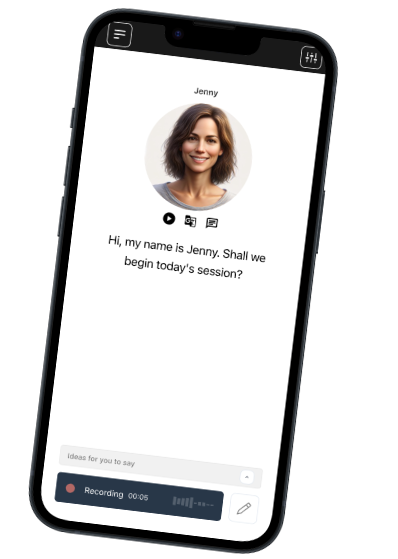
Talkio is the ultimate language training app that uses AI technology to help you improve your oral language skills!
Try Talkio