Can AI Conversation Practice Reduce Language Speaking Anxiety?
Last updated on
Editorial owner: Taylor Freeman · Editorial policy
AI conversation practice can create a lower-pressure place to begin speaking because the learner can pause, repeat, and make mistakes without managing another person's reaction. That can increase practice volume and help a difficult scenario feel familiar. It is best viewed as a step in gradual exposure, not a complete substitute for the unpredictable social skills involved in speaking with people.
Use a confidence ladder instead of avoiding people
- Begin with a private two-minute answer on a familiar topic.
- Repeat the same situation with an AI partner and practise recovering from one misunderstanding.
- Try the task with a supportive tutor, friend, or exchange partner.
- Move to a real-life version and judge success by completing the interaction, not by speaking perfectly.
The Anxiety-Performance Link Disappears With AI
A January 2026 study published in Frontiers in Psychology compared how 48 university students performed in speaking assessments, some facilitated by human instructors and others by an AI chatbot. The results were striking.
In the human-facilitated exams, there was a strong negative correlation between anxiety and scores (r = −0.500). Put simply, the more anxious a student felt, the worse they performed. This tracks with what most language learners already know intuitively: nerves kill fluency.
But in the AI-facilitated exams? The correlation between anxiety and performance essentially vanished (r = −0.042). Students who reported high anxiety still performed well. The AI did not magically cure their nervousness, but it stopped the anxiety from dragging down their actual speaking ability.
Think about what that means. The knowledge is already in your head. The vocabulary, the grammar, the pronunciation you have been studying. Anxiety is the bottleneck, and AI removes it from the equation.
Why AI Partners Lower the Stakes
A study published in Nature’s Humanities and Social Sciences Communications dug into the mechanisms behind this effect. Researchers found that AI conversation bots both enhanced L2 speaking skills and reduced Foreign Language Speaking Anxiety (FLSA). The combination matters: it is not just about feeling less nervous, it is about actually getting better at speaking while feeling less nervous.
The researchers identified several reasons AI partners create a lower-anxiety environment:
- No judgment. An AI will not raise an eyebrow at your pronunciation or silently judge your grammar. This removes the social evaluation fear that triggers anxiety in face-to-face conversations.
- Infinite patience. You can pause, restart, stumble, and try again without feeling like you are wasting someone’s time.
- Consistent availability. You practice when you are ready, not when a tutor has an opening. This sense of control alone reduces anticipatory anxiety.
- Safe failure. Making mistakes in front of an AI feels fundamentally different from making mistakes in front of a person. And mistakes are actually where the most learning happens.
Not All AI Tools Are Created Equal
Here is where the research gets nuanced, and where it matters which tool you choose. The OECD’s Digital Education Outlook 2026 found that AI can improve learning outcomes, but only when the tools are designed with explicit pedagogical purpose and integrated into sound teaching strategy.
In other words, opening ChatGPT and typing “practice Spanish with me” is not the same as using a platform specifically built for language conversation practice. General-purpose AI tools lack the structured feedback loops, pronunciation analysis, and pedagogical scaffolding that purpose-built language learning platforms provide.
A comparative study from System journal examined different conversational AI chatbots and their impact on willingness to communicate, speaking anxiety, and self-perceived communicative competence. The findings showed meaningful differences between platforms, confirming that the design and purpose of the AI tool significantly influences outcomes.
This is exactly why platforms like Talkio exist. Rather than repurposing a general chatbot, Talkio is built from the ground up as an AI speaking partner, with conversation scenarios designed to progressively build confidence and fluency. The difference between a purpose-built tool and a general one is the difference between a gym with a personal trainer and a room full of random equipment.
Digital Literacy Matters More Than You Think
One finding from the Frontiers study deserves special attention: students with higher digital literacy performed better in AI-facilitated assessments (r = 0.353). This suggests that comfort with technology itself plays a role in how much benefit you get from AI speaking practice.
The good news? Digital literacy for language learning is not about being a tech expert. It is about being willing to engage naturally with a conversational interface, to treat the AI like a real conversation partner rather than a test. The more naturally you interact, the more the anxiety-reducing benefits kick in.
For learners who grew up with smartphones and voice assistants, this comes naturally. For others, modern AI tools are adapting to meet learners where they are, with simpler interfaces and more forgiving conversation styles for beginners.
What This Means for Your Language Learning Routine
If the research tells us anything, it is that the traditional advice of “just force yourself to speak more” misses the point. For many learners, the problem is not insufficient practice, it is that anxiety turns every practice session into a stress test that undermines the learning itself.
Here is what the science suggests you actually do:
- Start speaking practice with AI before graduating to humans. Use AI conversation sessions to build a baseline of confidence. Once speaking feels natural with an AI partner, the jump to human conversation is far less intimidating.
- Practice regularly in short sessions. The anxiety-reducing effect builds over time. Five 10-minute AI conversations per week will do more for your confidence than one agonizing hour with a tutor.
- Choose a purpose-built tool. The OECD research is clear: pedagogical design matters. Pick a platform designed specifically for speaking practice, not a general chatbot you have to wrangle into being a language partner.
- Do not skip the hard conversations. Practice ordering food, making phone calls, giving presentations, all the scenarios that trigger the most anxiety. The safe environment of AI practice is exactly where you should tackle your weak spots.
- Track your comfort level, not just your accuracy. If you notice yourself hesitating less and speaking more freely over a few weeks, that is a meaningful sign of progress, even if your grammar is not perfect yet.
The Bigger Picture
We are at an inflection point in language education. For the first time, we have rigorous, peer-reviewed evidence that AI tools can address one of the most persistent problems in language learning, not by replacing human interaction, but by creating a safe bridge to it.
The latest AI in education statistics for 2026 show that adoption of AI-powered learning tools is accelerating across every sector, from universities to corporate training programs. The demand for AI-based language training is growing worldwide, and now we know why: it works, and the science is catching up to prove it.
Speaking anxiety does not have to be a permanent roadblock. With the right tools and a consistent practice habit, you can rewire how your brain responds to speaking in a foreign language. The research says so. Your next conversation in your target language might just be the easiest one you have ever had.
Talk Your Way
to Fluency
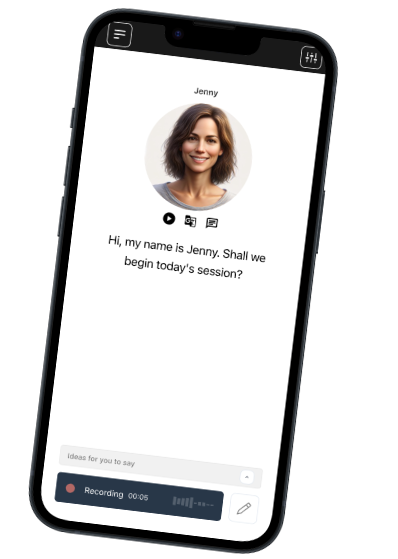
Talkio is the ultimate language training app that uses AI technology to help you improve your oral language skills!
Try Talkio