New Research Shows AI Can Now Adapt to Beginner Speakers: What This Means for Your Language Journey
Last updated on
Editorial owner: Taylor Freeman · Editorial policy
For years, the biggest catch-22 in language learning has been painfully simple: you need to speak to get better at speaking, but you are not good enough to speak. Beginners have been stuck in a loop of grammar drills, flashcards, and passive listening, all while the one thing that actually builds fluency, real conversation, stays out of reach.
That might finally be changing. A recent study from researchers at the University of Pennsylvania has shown that large language models can now be controlled to match a beginner’s level during conversation. Their findings suggest that with the right difficulty controls, AI conversation partners can serve even absolute beginners at the A1 and A2 levels of the Common European Framework of Reference (CEFR).
This is a big deal. Here is why.
The Problem with Traditional Conversation Practice
If you have ever tried to practice a new language with a native speaker, you know the feeling. They speak too fast. You freeze. They switch to English to be polite. You smile, nod, and quietly give up on speaking for the day.
Language exchange apps promised to solve this, but they come with their own frustrations: scheduling conflicts, unbalanced conversations, and the social pressure of performing in front of a stranger. For beginners especially, the anxiety of real-time conversation with another human can be paralyzing.
This is not just anecdotal. Research consistently shows that speaking anxiety is one of the top reasons language learners plateau or quit entirely. The gap between “I understand some words” and “I can hold a conversation” feels impossibly wide.
What the New Research Actually Found
The Penn study focused on something specific: can we make AI conversation partners that do not overwhelm beginners? Their approach used modular difficulty control techniques, essentially external guardrails that simplify vocabulary, shorten sentences, and slow down the conversational pace without retraining the entire AI model.
The results were striking. When tested with actual beginner learners, the controlled AI conversations led to significantly more engagement and comprehension compared to uncontrolled AI conversations. Beginners could actually keep up, respond, and, most importantly, keep talking.
This matters because previous AI language tools, including using ChatGPT in its default mode, tend to respond at a native level. They use complex grammar, idiomatic expressions, and vocabulary that sends beginners scrambling for a dictionary. The conversation dies before it starts.
Why “Just Talk to ChatGPT” Does Not Work for Beginners
You have probably seen the advice online: “Just use ChatGPT to practice your target language.” And yes, general-purpose AI can be useful for intermediate and advanced learners who already have the vocabulary to steer a conversation.
But for someone who just learned how to say “where is the bathroom” in Korean, a general AI tool is like being thrown into the deep end. It does not know your level. It does not simplify. It does not scaffold the conversation to help you build confidence gradually.
Purpose-built language learning platforms take a fundamentally different approach. They are designed to meet you where you are, adjusting difficulty in real time, providing pronunciation feedback, and creating structured scenarios that build your confidence step by step. Talkio, for example, offers AI conversation partners across more than 40 languages with built-in difficulty adaptation and real-time feedback on pronunciation.
The Confidence Factor: Why Adapted AI Conversations Change Everything
There is a psychological dimension here that goes beyond vocabulary lists. When a beginner successfully completes even a simple AI conversation, ordering coffee, introducing themselves, asking for directions, something shifts. The internal narrative changes from “I cannot speak this language” to “I just did.”
That shift is enormous. Studies in second language acquisition have long shown that self-efficacy, believing you can do something, is one of the strongest predictors of language learning success. Adapted AI conversations create a low-stakes environment where those early wins can happen.
Compare this to a traditional classroom where you raise your hand, stumble through a sentence, and hear your classmates giggle. Or a language exchange where your partner visibly loses patience. AI does not judge. It does not sigh. It waits, adapts, and keeps the conversation going.
What This Means for Your Study Routine
If you are a beginner or lower-intermediate learner, the practical takeaway is clear: speaking practice should not wait until you feel “ready.” The research suggests that AI-adapted conversation is effective precisely at the stages where most learners avoid speaking entirely.
Here is how to think about integrating AI conversation practice into your routine:
- Start with structured scenarios. Do not jump into free conversation. Begin with specific situations like ordering food, asking directions, or introducing yourself. Platforms like Talkio offer scenario-based conversations designed for this exact purpose.
- Aim for 10-15 minutes daily. Short, consistent sessions build more confidence than occasional hour-long marathons. Even brief daily practice compounds over time.
- Use pronunciation feedback. One advantage of AI over human partners is instant, objective feedback on your pronunciation without the social awkwardness.
- Track your progress. Notice when conversations start feeling easier. That is your brain building the neural pathways for real-time language production.
The Bigger Picture: AI Is Making Language Learning More Inclusive
For a long time, effective speaking practice was a privilege. You needed to live in a country where your target language was spoken, afford a private tutor, or be lucky enough to find a patient conversation partner. Beginners, introverts, and people with speaking anxiety were essentially locked out of the most effective form of language practice.
The convergence of better AI models, difficulty adaptation research, and purpose-built language platforms is changing that equation. A recent Business Insider report on “second wave” AI startups highlighted how AI language learning tools are moving beyond simple cost-cutting into genuinely new capabilities that were not possible before.
We are reaching a point where anyone with a phone and an internet connection can have a patient, adaptive conversation partner in dozens of languages. That is not a small thing. For the estimated 1.5 billion people actively learning a second language worldwide, the biggest bottleneck has always been practice. AI is quietly removing it.
Start Speaking Before You Feel Ready
The old model of language learning said: study grammar first, build vocabulary second, practice speaking last. The research is increasingly clear that this order is backwards. Speaking, even at a basic level, accelerates everything else. And with AI that can now genuinely adapt to your level, there has never been a lower barrier to getting started.
You do not need to be perfect. You do not even need to be good. You just need to start talking.
Talk Your Way
to Fluency
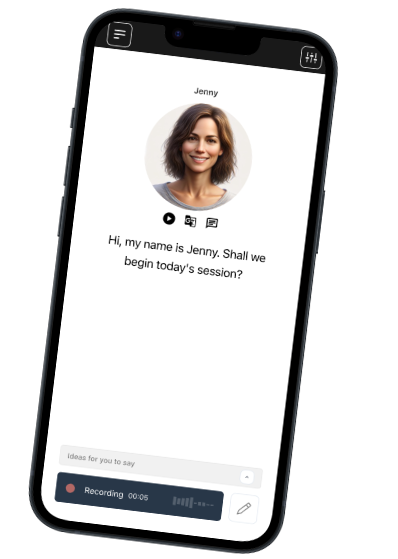
Talkio is the ultimate language training app that uses AI technology to help you improve your oral language skills!
Try Talkio