Can gestures help you remember new words? What the research says
Last updated on
Editorial owner: Taylor Freeman · Editorial policy
You probably learned vocabulary by looking at a word, reading its translation, and repeating it. That can work, but your voice and eyes do not have to do all the work. Research suggests that a simple, meaningful gesture can give a new word another route into memory.
Imagine learning the Spanish verb abrir, “to open.” You say the word while moving your hands apart as if opening a door. For alto, “tall,” you raise one hand above your head. The movement does not need to be clever or dramatic. It only needs to fit the meaning.
This idea comes from research on embodied learning, which studies how movement and the senses take part in thinking and memory. The findings are encouraging for language learners, but they do not mean every hand movement will make a word permanent. Gesture works best as part of real practice, with review, listening, and use in conversation.
What studies have found
A 2023 systematic review and meta-analysis examined seven studies with a total of 309 participants. It found that watching meaningful gestures could support second-language vocabulary learning just as well as performing the gestures in the tests included in the analysis. The authors also noted wide differences between studies and called for larger studies over longer periods. That is a useful result with a useful warning: gestures look promising, but the details matter.
Earlier experiments help explain why. In a 2011 study, adults learned words from an artificial language while making either iconic gestures, which matched the meanings, or meaningless movements. The learners remembered more of the words paired with meaningful gestures. Brain imaging also showed different patterns of activity. Words learned with matching gestures involved areas related to movement, while words learned with meaningless gestures relied more on areas associated with cognitive control.
A classroom study followed learners for 14 months. Participants learned 36 words by reading, hearing, and saying them. For half of the words, they also made symbolic gestures. Their translation tests showed a lasting advantage for the gesture condition. This was a small study with a limited word set, so it should not be treated as a promise about every learner. Still, it suggests that the benefit can last beyond one short laboratory session.
Movement may help because it adds information. A new word is no longer only a sound and a spelling. It is connected to a visual action and a physical feeling. When you later search for the word, any of those details may help you find it. A 2019 brain-imaging study also reported a short-term recall benefit when participants watched semantically related gestures during word learning.
The gesture must fit the word
Waving your hand randomly is not the same as acting out meaning. The 2011 study found a difference between meaningful and meaningless movement. This is important because it keeps the advice practical. You do not need to move more. You need to make a movement that gives the word a clear physical idea.
Some words make this easy. You can lift an imaginary cup for “drink,” point behind you for “yesterday,” or bring your hands together for “meet.” Abstract words take a little more thought. For “compare,” you might hold one hand on each side as if weighing two choices. For “agree,” you might bring two index fingers together. Your gesture does not need to match anyone else’s. If the connection makes sense to you, it can work as a personal memory cue.
There is another reassuring point in the research. You may gain something from watching a well-matched gesture even when you cannot move freely. The 2023 meta-analysis found no clear advantage for performing over observing gestures across its selected studies. If you are on a train, in an office, or dealing with limited mobility, careful observation can still be part of the exercise.
A ten-minute gesture routine
Try this with five useful words from your current lesson. Five is enough because the goal is to make strong connections, not to rush through a long list.
- Choose words that you expect to use soon. Verbs and words with a visible meaning are a good starting point.
- Listen to the pronunciation and say each word slowly. Make sure you know what it means in a normal sentence.
- Create one simple gesture that matches the meaning. Keep the same gesture each time you review that word.
- Say the word and make the gesture together three or four times. Then say a full sentence while using a smaller version of the movement.
- Look away from your notes. Make the gesture first and see whether the word comes back. Then reverse the test: say the word and recall the gesture.
- Use the words in a short spoken exchange. In Talkio, you could ask for a role-play that naturally includes your five words, then try to use them without reading.
Come back to the same words tomorrow and again later in the week. Gesture does not replace review. It gives the review more detail. Sleep may also support the consolidation of new vocabulary, which is why a short practice session followed by normal rest can be a sensible routine. You can read more about sleep and new-word memory.
Move from single words to real speech
Remembering a translation is only the first step. You also need to recognize the word at normal speed and use it while thinking about a message. Once a gesture helps you recall a word, place that word inside a common phrase. Instead of practising only “open,” practise “open the window,” “open the file,” or “the shop opens at nine.” This connects well with learning useful chunks instead of isolated words.
You can then use the phrase in a short dialogue. Make the gesture clearly during the first round. Make it smaller during the second. In the third round, try the sentence without moving. If you get stuck, bring the gesture back as a prompt. This gradual change helps you avoid depending on the movement forever.
Gesture practice also fits well beside listening and repetition. You might watch a speaker’s movement during a short clip, copy the sentence, and add a meaningful action for the word you want to remember. If you already use repetition exercises, the 15-minute speaking loop offers a way to move from imitation into your own sentences.
Keep the claim modest
The research does not show that gestures are a shortcut to fluency. Many studies use artificial languages, small groups, or limited vocabulary lists. Learners differ, and a movement that feels natural to one person may distract another. The recent meta-analysis also found substantial variation across studies.
That does not make the method useless. It tells us where to place it: as a low-cost experiment inside a balanced study routine. Try it with ten words and test yourself after a day and a week. Compare the result with ten words learned in your usual way. Your own recall will tell you whether the extra physical cue helps.
Most of all, use the remembered words. A word becomes useful when it appears in a request, a story, a meeting, or a joke. Speaking practice turns a study item into something you can reach for under real time pressure. Mistakes will happen during that process, and they provide information about what needs another round of practice. This guide on learning through speaking mistakes can help you keep going.
The next time a word refuses to stay in memory, give it a movement. Say it, show its meaning with your hands, and then put it into a sentence you might genuinely use. It is a small change to a study session, and the science gives us a good reason to try it.
Sources
- Oppici and colleagues, systematic review and meta-analysis of gesture observation and enactment, 2023
- Macedonia, review of gesture-supported second-language vocabulary learning, 2025
- Macedonia and colleagues, iconic gestures and word learning, 2011
- Macedonia and Klimesch, long-term classroom study, 2014
- Macedonia and colleagues, observed gestures and depth of encoding, 2019
Talk Your Way
to Fluency
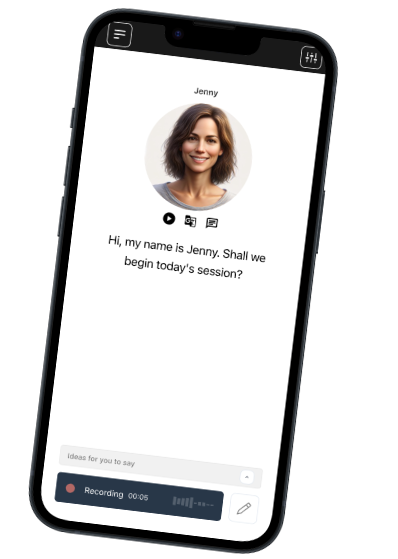
Talkio is the ultimate language training app that uses AI technology to help you improve your oral language skills!
Try Talkio