Why Making Mistakes Is the Fastest Way to Fluency (And How to Practice Without the Fear)
Last updated on
Editorial owner: Taylor Freeman · Editorial policy
BBC Learning English just launched a new podcast series called Beating Speaking Anxiety, and the very first episode tackles what might be the most universal fear among language learners: making mistakes. It is a topic that deserves more attention, because for millions of people around the world, the fear of saying something wrong is the single biggest reason they never start speaking at all.
If you have ever opened your mouth to say something in a new language, felt your heart race, and then stayed quiet instead, you are not alone. But here is something that might surprise you: those mistakes you are so afraid of are actually the engine that drives fluency.
The Mistake Paradox: Why Getting It Wrong Makes You Better
There is a well-documented phenomenon in language acquisition research called the foreign language anxiety effect. A 2026 study published in Frontiers in Education found that when learners felt comfortable making mistakes, their engagement, willingness to participate, and overall learning outcomes all improved significantly. The research showed that reduced fear of errors led to “higher levels of engagement, an important factor in achieving success in language learning.”
This is not new science, but it is becoming harder to ignore. When you make a mistake and get corrected, your brain creates a stronger memory trace than when you simply hear the right answer passively. Neuroscientists call this the “generation effect,” and it explains why your brain actually learns better through active production, even when that production is imperfect.
Think of it this way: every mistake is a data point your brain uses to recalibrate. Miss a verb conjugation? Your brain flags it. Use the wrong word order? Your brain takes note. Over time, these micro-corrections compound into genuine fluency, but only if you keep speaking.
Why We Fear Mistakes (And Why the Fear Is Worse Than the Mistakes)
The fear of making mistakes in a foreign language is deeply rooted in psychology. It comes down to three main triggers:
- Fear of negative evaluation: Worrying that native speakers, teachers, or classmates will judge your ability based on errors.
- Perfectionism: The belief that you should not speak until you can do it correctly, which creates a catch-22 since you cannot improve without practice.
- Identity threat: In your native language, you are articulate and nuanced. In a new language, you sound like a child, and that gap between who you are and how you sound feels genuinely uncomfortable.
The BBC’s new podcast series interviews experts who confirm that these fears are nearly universal. Their key insight? The anxiety itself causes more damage than the mistakes ever could. When you are anxious, your working memory shrinks, your vocabulary retrieval slows down, and you make more errors, not fewer. It becomes a self-fulfilling prophecy.
What Successful Language Learners Do Differently
Research on successful language learners consistently shows they share one trait: a willingness to tolerate ambiguity and imperfection. They speak before they are ready. They guess when they are unsure. They laugh at their own errors instead of cringing.
But telling someone to “just stop worrying about mistakes” is about as useful as telling someone with a fear of heights to “just look down.” The fear is real, and it needs a practical solution.
That is where the environment matters more than the mindset. If you practice in a setting where mistakes carry zero social consequences, the fear naturally dissolves. You do not need to be brave. You just need a safe space to be imperfect.
The Private Practice Revolution
One of the most significant shifts in language learning over the past two years has been the rise of AI conversation partners. Not because the technology is flashy, but because it solves the core emotional problem: it removes the audience.
When you practice speaking with an AI, there is no one to judge you. No awkward pauses while a tutor searches for a polite way to correct you. No classmates listening to your stumbling attempts. You can mangle a sentence six times in a row, and the only response you will get is patient, constructive feedback.
A 2026 study in the International Journal of Interactive Mobile Technologies found that mobile-assisted language learning with adaptive feedback significantly improved speaking fluency while reducing anxiety. The key factor was not the technology itself, but the psychological safety it created.
This is exactly the approach behind platforms like Talkio AI, which focuses entirely on conversation practice with AI tutors. The idea is simple: give learners a space where they can speak freely, make mistakes, and get immediate corrections without any social pressure. With over 400 AI tutors across 40+ languages, it creates the kind of low-stakes practice environment that research says learners need most.
A Framework for Productive Mistakes
Not all mistakes are equal. Some are more useful than others. Here is a framework for turning your errors into accelerators:
1. Aim for “stretch zone” conversations. Choose topics that push you slightly beyond your comfort level. If you can say everything perfectly, you are not learning. If you cannot say anything at all, you are overwhelmed. The sweet spot is conversations where you make mistakes roughly 20-30% of the time.
2. Notice the pattern, not just the correction. When you get corrected, do not just memorize the right answer. Ask yourself: why did I say it that way? Was it interference from my native language? A grammar rule I have not internalized? A vocabulary gap? Patterns are more valuable than individual corrections.
3. Repeat the same conversation. One of the most underused techniques in language learning is repetition. Have the same conversation about ordering coffee three days in a row. Each time, you will make fewer mistakes, and the correct forms will start to feel automatic. This works especially well with scenario-based AI practice, where you can replay situations until they feel natural.
4. Keep a mistake journal. Write down your three most interesting mistakes each week. Not to shame yourself, but to track your progress. After a month, you will notice that your mistakes have evolved, which means your language level has too.
5. Celebrate the “good mistakes.” A “good mistake” is one where you tried to express something complex and got it slightly wrong. That is infinitely more valuable than saying simple things perfectly. If you said “I have hunger” instead of “I am hungry” in Spanish, congratulations: you attempted a real thought in another language. That took courage.
The Real Risk Is Not Speaking at All
Here is the uncomfortable truth that the research on corrective feedback timing makes clear: the longer you wait to start speaking, the harder it gets. Passive knowledge (reading, listening) builds up, creating an ever-widening gap between what you understand and what you can produce. The gap itself becomes another source of anxiety.
Learners who start speaking early, even badly, develop stronger production pathways and experience less of the “freeze” response when they eventually need to speak in real situations. Every mangled sentence you practice now is one fewer awkward silence in a real conversation later.
The language learning industry has spent decades optimizing for correctness: perfect grammar drills, flawless pronunciation guides, error-free exercises. But fluency does not come from avoiding mistakes. It comes from making so many mistakes that the correct patterns become second nature.
So the next time you hesitate before speaking, remember: the mistake you are about to make is not a failure. It is a lesson your brain needs in order to move forward. The only real mistake in language learning is staying silent.
Talk Your Way
to Fluency
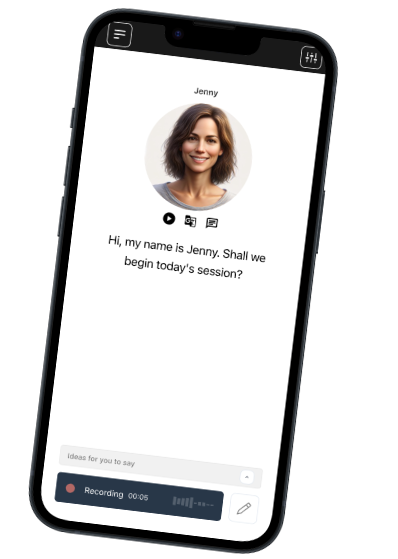
Talkio is the ultimate language training app that uses AI technology to help you improve your oral language skills!
Try Talkio