

Why listening to more voices can train your ear
Last updated on
Editorial owner: Taylor Freeman · Editorial policy
Real conversations rarely sound like a language lesson. One person speaks quickly, another has a lower voice, and someone else uses a regional accent. You may understand your teacher perfectly and still need a few seconds to adjust to a new speaker.
That is not a sign that your listening is poor. Your ear has learned one version of the language, and now it needs more examples. Research on high variability phonetic training, often shortened to HVPT, suggests that carefully practising with several voices can help learners notice difficult sounds and understand speech beyond the person they already know.
The idea is simple: do not let one voice become your whole listening world.
Why a familiar voice feels easier
Every voice carries more than words. Pitch, speed, age, accent, and speaking style all change the signal that reaches your ear. When you hear the same teacher or recording many times, you get good at understanding that speaker. This is useful, but some of your success may depend on details that belong to the person rather than the language.
Several voices give your brain a harder job. It must work out what stays the same when the speaker changes. For example, the English vowel in ship will never sound completely identical across five people, but it must remain different enough from the vowel in sheep. Comparing those examples can help a learner pay attention to the sound difference that matters.
A classic study trained Japanese listeners to identify English r and l. Learners who heard several talkers improved and could apply what they learned to new words and an unfamiliar voice. A group trained with one talker improved too, but did not generalise to a new talker in the same way. The researchers concluded that variability can support the formation of stronger sound categories. You can read the 1993 study in the Journal of the Acoustical Society of America.
What the wider research says
One old experiment is interesting, but a large review gives us a better view. A 2025 meta-analysis brought together 79 studies of high variability phonetic training. It found medium to large improvements in second-language speech perception. The review also found evidence that gains can last and can transfer to new material, although results differed according to the sounds, tasks, training time, and number of talkers used. The full meta-analysis is published in Studies in Second Language Acquisition.
A separate meta-analysis of 18 controlled studies reported a medium overall effect on pronunciation learning. Effects were not identical for every learner or sound. Consonants and lexical tones showed stronger results in that review, while other cases produced smaller or uncertain effects.
There is also evidence that this work can reach beyond a sound test. In an online study, French learners of English completed eight sessions focused on the English h sound. Their sound identification and word recognition improved, and the gains were still present four months later. That result is encouraging because conversation depends on recognising words, not just choosing a sound in a laboratory task. The study is available through Bilingualism: Language and Cognition.
More voices are useful, but not magic
The honest version of this advice needs a limit. More variety does not always produce better learning. A controlled study with Greek-speaking children and adults compared training with four voices against training with one. Both groups improved, but the study did not find the expected advantage for multiple voices. In some conditions, one voice was easier. The authors noted that the task, test, learner group, and starting differences may have affected the result. You can read the open study in PeerJ.
This makes practical sense. If a sound is completely new to you, too much variation at once may feel like noise. A stable example can help you hear the basic contrast first. Then a few new voices can test whether you truly recognise it.
The best lesson is not to collect as many accents as possible. Start clearly, add variety gradually, and keep feedback in the routine.
A 15-minute many-voices listening routine
You do not need specialist software to borrow the main idea. Try this short routine two or three times a week.
- Choose one small target. Pick a sound contrast, a group of useful phrases, or one listening problem. English learners might choose ship and sheep. A Mandarin learner might work on two tones. Keep the target narrow enough to notice.
- Begin with one clear voice. Listen to five or six examples. Repeat them aloud and check the meaning. If you cannot hear the difference yet, slow down and stay with this voice for a little longer.
- Add three or four voices. Use short clips from different speakers. Keep the words or phrases similar so the changing voice is the main source of variety. Try to identify the target before checking the answer.
- Say the examples yourself. Listening and speaking support each other, but they are not the same skill. Record a few attempts or use a speaking tool that gives pronunciation feedback.
- Finish with a new voice. Test yourself on someone you did not hear during practice. This final step shows whether the sound has become portable.
If you want a broader listening routine, combine this exercise with Talkio’s three-pass subtitle method. The first pass checks what you can hear unaided. Later passes help you connect the sound with the written phrase and its meaning.
Turn listening into conversation
Sound training helps most when you bring it back into real speech. After your listening set, have a short conversation that contains the target words. In Talkio, you can choose different tutor voices and accents, then ask for a roleplay where the words are likely to appear. A travel conversation, work meeting, or café order is enough. The point is to recognise the sound while you are also following meaning.
Do not spend the whole session judging single sounds. Say complete sentences. If you receive a correction, keep the useful example and try it again in a later conversation. A small speaking error log can help you turn repeated pronunciation problems into a short practice list.
You can also use shadowing as one part of a speaking loop. Copy a clear model first, then answer an unscripted question in your own words. This prevents pronunciation practice from becoming pure imitation.
When a particular sound feels awkward, a few slow repetitions may help your mouth learn the movement. Talkio’s article on using tongue twisters for pronunciation explains how to keep that practice controlled rather than racing through mistakes.
The encouraging part
Difficulty with a new speaker does not erase the listening skill you already have. It shows you where that skill is still tied to familiar conditions. With a small amount of planned variety, you can train your ear to find the same words inside different voices.
Keep the steps manageable. Learn the contrast from a clear model, compare a few speakers, test yourself with someone new, and use the sound in a conversation. You are teaching your ear a practical lesson: the language belongs to many voices, and you can learn to understand more of them.
Sources
- Uchihara, Karas, and Thomson, meta-analysis of 79 HVPT studies, 2025
- Mahdi and Mohsen, meta-analysis of HVPT and pronunciation learning, 2024
- Lively, Logan, and Pisoni, talker variability and English r/l learning, 1993
- Melnik and Peperkamp, online HVPT and word recognition, 2020
- Giannakopoulou and colleagues, high versus low talker variability, 2017
Talk Your Way
to Fluency
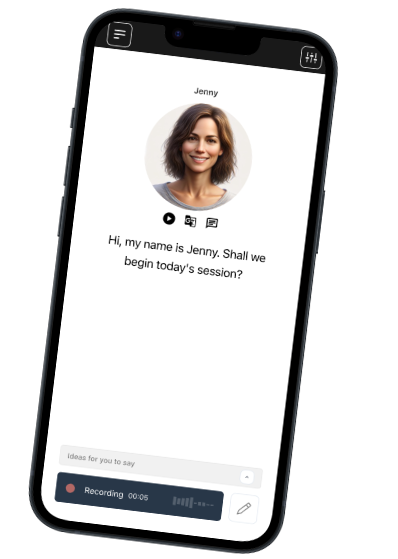
Talkio is the ultimate language training app that uses AI technology to help you improve your oral language skills!
Try Talkio