How to Practice Speaking a Language Alone, and Why AI Warm Ups Work Better in 2026
Last updated on
Editorial owner: Grzegorz Markowski · Editorial policy
A lot of language learners have the same annoying problem. You understand more than you can say, you know you need speaking practice, and then reality shows up. No partner, no tutor booked, no native speaker in your kitchen, no clean thirty-minute block where you suddenly become disciplined.
So people default to passive study. They read, review flashcards, watch videos, maybe do a grammar drill and call it progress. It is not useless, but it also does not solve the real problem. Speaking is a performance skill. If your mouth is not doing the work, your confidence usually stays stuck.
That is why one of the more interesting language learning shifts in 2026 is not just AI for language learning in the abstract. It is the rise of solo speaking routines, especially short voice warm ups that help learners move from silent knowledge to actual speech. You can see the demand in fresh Reddit threads from learners asking how to practice speaking when nobody around them speaks the language. The question is everywhere because the old answer, just find a partner, is not enough.
The good news is that practicing alone is absolutely possible, if you stop treating it like a fake version of real conversation. Done right, solo speaking is not a backup plan. It is the bridge that makes real conversations less terrifying.
Why passive study stops helping at a certain point
Most learners hit a wall where input keeps going up but output does not. You can recognize phrases, follow slow podcasts, maybe even understand work meetings better than before. Then someone asks you a simple question and your brain leaves the building.
That freeze is not proof that you are bad at languages. It usually means you have not rehearsed retrieval under speaking conditions. Talkio has already written about why fear and self-correction slow speaking progress, and the pattern is the same across levels. Recognition is easier than production. Speaking asks you to retrieve words fast, choose grammar on the fly, manage pronunciation, and keep going while your inner critic throws elbows.
That is exactly why a solo routine works. It lowers the social pressure while keeping the production demand. You still have to form thoughts out loud. You still notice gaps. You still build speaking stamina. You just do it without the emotional chaos of a live human waiting on your answer.
The best solo speaking routine is not complicated
If people make one mistake here, it is overengineering the whole thing. You do not need a fancy ritual. You need a repeatable loop you will actually use. A solid solo speaking session can be ten to fifteen minutes and still do more for your fluency than another night of pretending subtitles count as speaking practice.
Here is a simple structure that works:
- Pick one tiny scenario. Ordering coffee, introducing yourself in a meeting, explaining your weekend, asking for help, answering what do you do.
- Speak out loud for two minutes without stopping. No writing first. No perfectionist reset every six seconds.
- Record yourself. This is annoying, which is exactly why it works.
- Listen back and mark three friction points. Missing vocabulary, awkward sentence order, pronunciation slips, too many pauses.
- Repeat the same scenario once more. Immediate repetition matters.
This is basically deliberate practice for speaking. Not glamorous, very effective. It also lines up with what many learners are sharing right now in online communities, especially the record, notice, repeat loop.
Where AI warm ups actually help
Now we get to the 2026 part. AI voice tools are getting better at one specific job, they make it easier to turn solo practice into guided rehearsal. That matters because the biggest problem with practicing alone is not knowing what to say next. Once you run out of prompts, many sessions die.
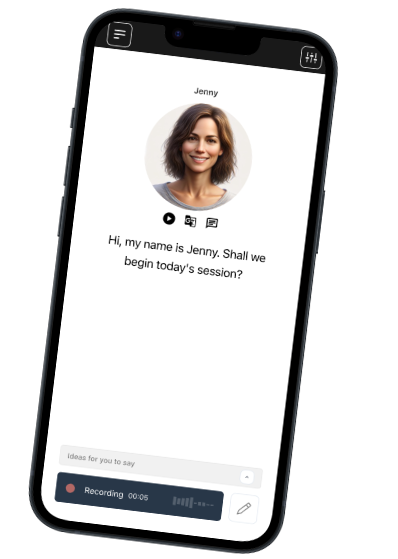
An AI speaking partner fixes that by keeping the exchange moving. You can ask it to stay at your level, roleplay a situation, correct only major mistakes, or push you with follow-up questions. That is a lot more useful than generic talk to yourself in the mirror advice.
Still, let’s not get stupid about it. AI is not magic, and it is not a replacement for every human interaction. The sweet spot is using it as a warm up layer. Think of it like conversation rehearsal before the real game. That idea connects closely to Talkio’s earlier piece on conversation rehearsal for high-stakes talks. The same logic works for everyday learners. Rehearsal makes real speech smoother.
If you want a practical system, use this order:
- Start with two minutes of solo talking.
- Move into five minutes with an AI conversation partner.
- Ask for targeted corrections on the exact mistakes you just noticed.
- Redo your original scenario one more time.
That progression works because it turns passive awareness into active correction. You are not just using AI. You are using AI at the moment it can actually help.
The real goal is confidence through repetition, not perfect speech
A lot of learners secretly believe they need to sound good before they practice out loud. That is backwards. You sound better because you practice out loud. Confidence usually shows up after reps, not before them.
There is also a mental shift that helps. Stop judging a session by whether it felt fluent. Judge it by whether you produced language under a little bit of pressure. If you hesitated, searched, corrected yourself, and kept going, that was a useful session.
That is one reason the broader market is moving toward conversation-focused tools. Even Microsoft’s push into live translation inside meetings has made the same thing clearer, not less important. Translation can reduce friction, but it cannot build your speaking reflexes for you. Talkio made a version of that argument in this recent piece on auto-translated meetings. If your job, studies, or daily life depend on actually speaking, you still need rehearsal.
Three solo speaking drills worth stealing this week
1. The daily recap drill.
At the end of the day, explain what happened in your target language for three minutes. Keep it simple. What you did, who you talked to, what annoyed you, what is next tomorrow.
2. The pressure question drill.
Take common questions like Tell me about yourself, What kind of work do you do, or Why are you learning this language. Answer them out loud five different ways. This is brutally practical.
3. The rescue drill.
Practice what to say when you get stuck. Phrases like Let me say that another way, I know the idea but not the word, or Can I explain it more simply. These lines keep conversations alive. They are underrated as hell.
If you want more structure around spoken mistakes, pronunciation, and detailed feedback, Talkio has also covered what a last-minute speaking warm up looks like, the current AI speaking practice landscape, and why AI conversation tools can reduce speaking anxiety.
What to use as prompts when your mind goes blank
This is where most solo practice collapses, so keep a short prompt bank. You do not need fifty. You need enough to avoid dead air.
- Describe your morning routine.
- Explain a problem from work or school.
- Give someone directions.
- Recommend a movie or book.
- Tell a short story about a mistake you made.
- Roleplay a doctor visit, job interview, or customer support call.
If you use AI for this, give specific instructions. Ask for short follow-up questions. Ask it to keep the topic realistic. Ask it to correct only the top two or three issues. Better prompts produce better practice.
One honest warning
If your solo practice never becomes interactive practice, you can still plateau. Solo work is the on-ramp, not the whole highway. The point is to build enough fluency and calm that real conversations stop feeling like a street fight.
But as an on-ramp, it is incredibly effective. For busy adults, shy learners, and anyone without easy access to speaking partners, it removes the biggest excuse. You can practice today, in your room, with your own voice, and make measurable progress.
The takeaway
If you want to practice speaking a language alone, stop waiting for the perfect partner and stop hiding in passive study. Use short, repeatable speaking drills. Record yourself. Repeat scenarios. Then use AI as a warm up partner, not a gimmick, to keep the conversation going and sharpen weak spots.
That is the real shift in 2026. The best learners are not replacing effort with AI. They are using AI to make speaking practice easier to start, easier to repeat, and a lot harder to avoid.
If that sounds like the kind of practice you actually need, Talkio is built for exactly this kind of real conversation rehearsal, with a free trial that lets you test the routine instead of just reading about it.
Sources: recent Reddit discussion on solo speaking practice, recent Reddit discussion on AI for language learning, ScienceDaily language acquisition coverage, Exploding Topics on 2026 LLM trends.
Talk Your Way
to Fluency
Talkio is the ultimate language training app that uses AI technology to help you improve your oral language skills!
Try Talkio