How to Nail a Business Presentation in a Language You Are Still Learning
Last updated on
Editorial owner: Taylor Freeman · Editorial policy
The Boardroom Is the Hardest Classroom
You know the grammar. You have passed the exams. You can read emails, follow meetings, and even crack a joke at the coffee machine in your second language. But then someone says, “Can you present the quarterly results to the Hamburg office on Friday?” and your stomach drops.
Presenting in a foreign language is one of the most stressful professional challenges that multilingual workers face. According to a Harvard Business Review study on second-language cognition, professionals who are fluent enough for everyday conversation often hit a wall when they need to perform under pressure, especially when slides, data, and an expectant audience are involved.
The good news: you do not need to reach native-level fluency to deliver a compelling business presentation. What you need is targeted preparation, the right practice strategy, and a few techniques that experienced multilingual presenters swear by.
Why Presentations Feel Harder Than Conversations
In casual conversation, you share the cognitive load with the other person. They nod, ask follow-up questions, and fill awkward pauses with their own words. A presentation strips all of that away. You are alone on stage, expected to deliver polished sentences one after another with no safety net.
Linguists call this the difference between interactive and transactional speaking. Interactive speaking (chatting with colleagues) lets you negotiate meaning in real time. Transactional speaking (presenting, lecturing) demands planned fluency, which is the ability to produce extended, coherent speech without relying on your conversation partner to keep things moving.
This is why someone who sounds perfectly fluent at lunch can stumble through a ten-minute presentation. Different skill, different preparation.
Step 1: Script the Skeleton, Not the Speech
The biggest mistake non-native presenters make is writing out their entire presentation word for word and then trying to memorize it. This backfires spectacularly. The moment you forget one sentence, the whole house of cards collapses.
Instead, create what presentation coaches call a phrase scaffold:
- Write out your opening sentence and your closing sentence verbatim. These are high-pressure moments that benefit from exact wording.
- For everything in between, write only bullet points with key phrases, not full sentences.
- Identify 5-10 technical terms or industry-specific words you will need, and practice pronouncing them out loud at least 20 times each.
This approach gives you anchor points while leaving room for natural, spontaneous speech. It also makes you more resilient when something unexpected happens, like a question from the audience or a slide that loads in the wrong order.
Step 2: Practice Out Loud (Not in Your Head)
Silent rehearsal does almost nothing for foreign-language presentations. Your brain processes language differently when you read it versus when you speak it. The motor memory of physically forming words, controlling your breathing, and projecting your voice can only be built by actually doing it.
Research on speaking anxiety and language performance consistently shows that the number one predictor of presentation confidence is simply how many times you have spoken the material out loud before the real event.
Here is a practical rehearsal schedule for a 15-minute presentation:
- Five days before: Talk through your bullet points informally, as if explaining to a friend. Do not worry about polish.
- Three days before: Do a full run-through with your slides. Record yourself and listen back, focusing on pacing rather than grammar.
- One day before: Practice your opening, your transitions between sections, and your closing. These are the moments where hesitation is most visible.
- Morning of: Do a quick speaking warm-up to get your mouth used to producing the target language.
Step 3: Master the Transitional Phrases
Native speakers glide between sections of a presentation using filler phrases that sound effortless: “Moving on to…”, “This brings me to…”, “So what does this mean in practice?” These transitions are invisible to native ears, but for non-native speakers, they are lifesavers.
Memorize 8-10 transition phrases in your target language and practice dropping them in naturally. They buy you thinking time, signal structure to your audience, and make you sound significantly more fluent than you might actually feel. A Scientific American analysis of bilingual cognition found that formulaic expressions (phrases stored as chunks rather than assembled word by word) are processed faster under stress, which is exactly what you need when presenting.
Some universally useful ones to have ready:
- “Let me give you some context on this.”
- “The key takeaway here is…”
- “I want to highlight one thing before we move on.”
- “This connects back to what I mentioned earlier about…”
Step 4: Use AI Conversation Practice for Realistic Rehearsal
One of the hardest parts of preparing a foreign-language presentation is finding someone to practice with. Colleagues are busy, tutors are expensive, and practicing alone lacks the pressure of a real listener.
This is where AI conversation partners have become genuinely useful. Tools like Talkio AI let you simulate presentation scenarios, practice explaining complex ideas in your target language, and get instant feedback on pronunciation, all without scheduling a session or feeling judged.
The advantage over practicing alone is the responsive element. When an AI asks a follow-up question or challenges a point, you are forced to think on your feet in the target language, which is exactly the skill you need when someone in the audience raises their hand.
For the best results, try structuring your AI practice sessions like this:
- Explain your main argument in 2-3 minutes, as if presenting to a colleague who knows nothing about the topic.
- Practice answering likely questions: “What is the budget impact?”, “How does this compare to last quarter?”, “What are the risks?”
- Rehearse handling the unexpected: ask the AI to challenge your assumptions or change the topic suddenly.
Step 5: Slow Down (Seriously, Even Slower Than That)
Non-native presenters almost universally speak too fast. This is counterintuitive, since you would expect nervousness to cause freezing rather than racing, but the psychology is clear: research on speech anxiety shows that speakers rush through material to minimize their time in the uncomfortable spotlight.
The irony is that speaking slowly actually makes you sound more confident and more fluent. It gives your brain time to find the right words, gives your audience time to process your accent, and gives you time to breathe.
A practical trick: find a TED talk in your target language and note how slowly the speaker moves through their points. Then aim to match that pace. You will feel like you are crawling, but to your audience, you will sound measured and authoritative.
Step 6: Prepare for the Q&A Separately
Many presenters focus all their energy on the slides and treat the Q&A as an afterthought. For non-native speakers, this is a critical mistake. The Q&A is the unscripted part, the moment where your language skills are most exposed.
Before your presentation, brainstorm 10 questions your audience might ask. Write them down in the target language. Then practice answering each one out loud, twice. You will not predict every question, but you will build the vocabulary and sentence patterns you need for the most likely ones.
If you get a question you do not understand, have a few phrases ready: “Could you rephrase that?”, “Just to make sure I understand, are you asking about…?” These are not signs of weakness. Even experienced professionals in multilingual corporate settings use clarification strategies constantly.
The 2026 Reality: Multilingual Presentations Are the New Normal
Presenting in a foreign language used to be an edge case, something that only expatriates and international sales teams worried about. That is changing fast. With multilingual learning becoming a top L&D priority in 2026, more companies are expecting employees at every level to communicate across language barriers.
The bilingual bonus in the job market is real and growing. But the professionals who benefit most are not the ones with the best grammar scores. They are the ones who can stand up, present their ideas clearly, and handle tough questions, all in a language they are still learning.
That is a skill you can build. It starts with the right preparation, enough spoken practice, and the confidence that comes from showing up to the podium already knowing how your words will sound.
Your next presentation in a foreign language does not have to be terrifying. With a phrase scaffold, targeted rehearsal, and a smart use of AI practice tools, it can be the moment your career goes international.
Talk Your Way
to Fluency
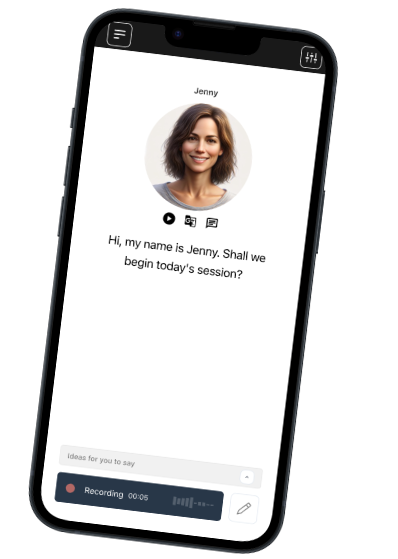
Talkio is the ultimate language training app that uses AI technology to help you improve your oral language skills!
Try Talkio