Practising Conversations in Your Head: Benefits and Limits
Last updated on
Editorial owner: Taylor Freeman · Editorial policy
Rehearsing a conversation in your head can help you anticipate vocabulary, organize an explanation, and feel more prepared. It does not train articulation, listening, timing, or the need to respond when another person says something unexpected. Mental practice becomes much more useful when it is followed by an audible attempt and a version that changes the scenario.
Turn mental rehearsal into speaking practice
- Imagine a specific setting and communication goal rather than a perfect conversation.
- Say your response aloud without reading and notice where words fail to arrive.
- Add an interruption, follow-up question, or misunderstanding that forces you to adapt.
- Finish by recording one natural version, then stop rehearsing and use it in real interaction.
You Already Practice Conversations in Your Head, Here Is Why That Actually Matters
You are standing in line at the coffee shop in Barcelona. In your mind, you have already ordered your café con leche three times. You have rehearsed the polite smile, the casual “gracias,” maybe even a follow-up comment about the weather. But when it is your turn, something short-circuits. The words evaporate. You point at the menu and mumble.
If this sounds familiar, you are not alone. Millions of language learners spend hours each day having imaginary conversations in their target language. On forums like Quora, thousands of learners confirm the same habit: elaborate internal rehearsals that never quite translate to real-world fluency.
But here is the thing, this habit is not a sign of failure. It is actually a sign that your brain is doing exactly what it should. The problem is not the rehearsal itself. The problem is that most learners stop there.
The Science Behind Mental Rehearsal
Psychologists have a name for what you are doing: inner speech. Research published in Frontiers in Psychology shows that inner speech plays a critical role in language processing, working memory, and even emotional regulation. When you rehearse a conversation in your head, your brain activates many of the same neural pathways it would use during actual speech.
This is not just daydreaming. Your brain is building linguistic patterns, testing grammar structures, and retrieving vocabulary from long-term memory. Athletes have used a similar technique, mental visualization, for decades. A basketball player imagining free throws activates the same motor cortex regions as physically shooting the ball.
The same principle applies to language. When you mentally practice ordering that coffee, your brain is genuinely preparing. But there is a crucial gap between mental rehearsal and spoken fluency, and it comes down to one thing: your mouth.
Why Thinking Is Not the Same as Speaking
Inner speech skips the hardest part of language production. It skips the physical act of moving your tongue, lips, and jaw in unfamiliar patterns. It skips the pressure of real-time processing, where you cannot pause to think of the subjunctive form of “querer” for thirty seconds. And it skips the emotional weight of being heard, and potentially misunderstood, by another person.
This is why so many learners experience what researchers call the comprehension-production gap. You understand everything. You can read novels, follow podcasts, and even think in your target language. But the moment you need to produce speech under social pressure, your brain freezes.
The solution is not to stop rehearsing mentally. The solution is to close the loop by adding spoken output to the equation.
From Inner Rehearsal to Spoken Practice: Bridging the Gap
Here is where it gets interesting. The mental rehearsal habit that so many learners feel guilty about is actually the perfect foundation for effective speaking practice. You have already done the hard cognitive work of planning what to say. Now you just need to say it out loud.
There are several ways to bridge this gap, and they range from low-tech to cutting-edge:
Talk to yourself out loud. It sounds silly, but research on self-directed speech shows that narrating your daily activities in your target language builds fluency faster than passive study. Next time you catch yourself rehearsing a conversation mentally, try saying it out loud instead. Even whispering counts.
Record yourself and listen back. This adds accountability. When you hear your own pronunciation, you notice gaps that inner speech conveniently glosses over. You might discover that the French “r” you have been mentally nailing actually sounds nothing like what you imagined.
Practice with an AI conversation partner. This is where technology has genuinely changed the game. Unlike a human conversation partner, an AI conversation partner does not judge, does not lose patience, and is available at 2 AM when you are lying in bed rehearsing tomorrow’s meeting in German. Tools like Talkio let you take those mental rehearsals and turn them into actual spoken conversations, complete with real-time feedback on pronunciation and grammar.
Why AI Makes This Easier Than Ever
The biggest barrier to moving from mental to spoken practice has always been social anxiety. A Cambridge University review of language learning studies found that speaking anxiety is the single most common reason learners avoid conversation practice. It is not laziness. It is fear.
This is exactly the gap that AI conversation practice fills. When you talk to an AI, there is no social consequence for getting it wrong. There is no awkward pause while a native speaker tries to figure out what you meant. There is no embarrassment when you accidentally say something inappropriate because you confused two similar-sounding words.
What there is, however, is genuine spoken output. Your mouth moves. Your brain processes language in real time. You practice recovering from mistakes, finding alternative words when you forget the one you want, and maintaining the flow of a conversation without the safety net of your inner monologue.
For learners who have been preparing for a work meeting in their second language, this is transformative. Instead of running the same mental script twenty times, you can actually rehearse the meeting out loud with an AI that responds unpredictably, just like a real colleague would.
How to Turn Your Inner Conversations Into a Practice Routine
If you recognize yourself as a mental rehearser, here is a simple framework to start converting that habit into real progress:
Step 1: Notice when you are rehearsing. Pay attention to the moments when you catch yourself having imaginary conversations in your target language. For most people, this happens during commutes, before sleep, or while doing mundane tasks.
Step 2: Say it out loud. The next time you catch yourself in a mental conversation, switch to speaking. Even if you are on a bus, you can whisper. The physical act of producing sound is what bridges the gap.
Step 3: Add a conversation partner. Once you are comfortable speaking to yourself, level up by speaking to someone, or something, that responds. An AI conversation tool gives you the spontaneity of real dialogue without the stakes of human interaction. This is where platforms like Talkio shine, because they are built specifically for this kind of structured speaking practice.
Step 4: Graduate to real conversations. With enough AI practice, the gap between your mental rehearsals and real-world performance starts to close. The coffee order in Barcelona stops feeling like a performance. It just feels like ordering coffee.
The Habit You Already Have Is Your Superpower
Most language learning advice tells you what to start doing. Start flashcards. Start a course. Start watching TV in your target language. But the truth is, if you are already rehearsing conversations in your head, you have been doing something incredibly valuable without even realizing it.
Your brain has been building the architecture of fluency in the background. All you need to do now is give it an outlet. Speak those conversations out loud. Let an AI challenge you with unexpected responses. Practice the messy, imperfect, beautiful act of actually talking.
Because the difference between someone who thinks in a language and someone who speaks it is not talent, not time abroad, not a perfect grammar score. It is simply the willingness to open your mouth and try.
Talk Your Way
to Fluency
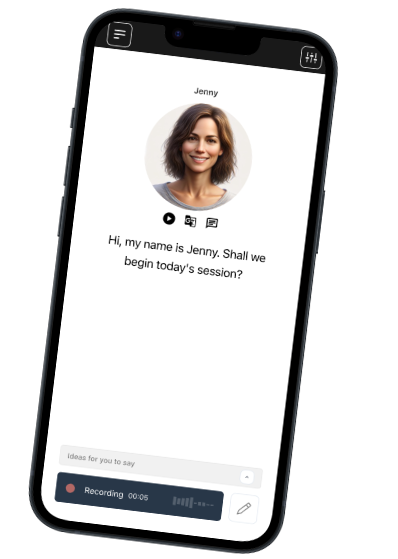
Talkio is the ultimate language training app that uses AI technology to help you improve your oral language skills!
Try Talkio